
Blog
What Does a DC-DC Battery Charger Do? How It Works, Types & Sizing Guide (2026)
2026-06-12 | Calvin
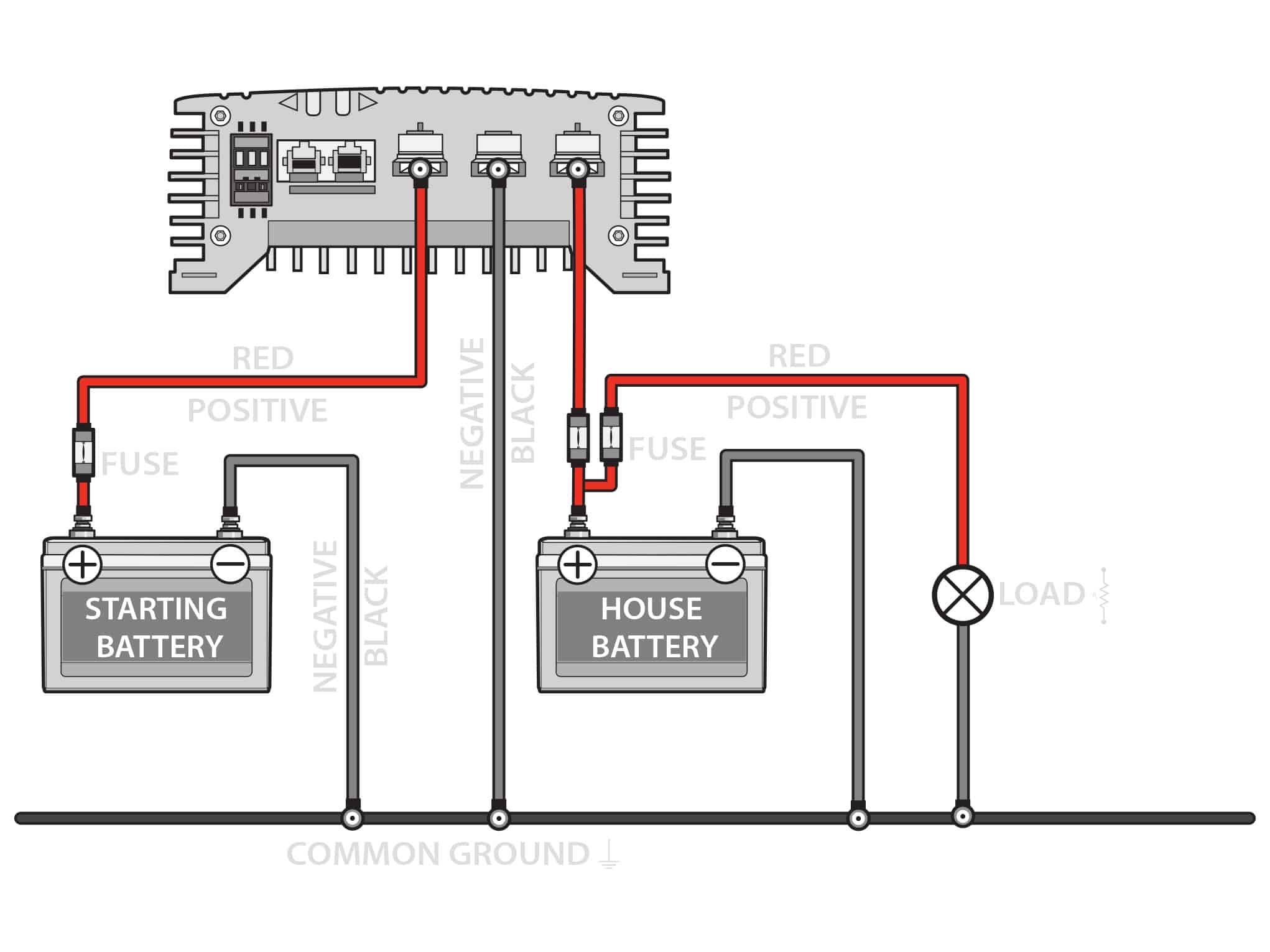
A DC-DC battery charger does one thing that sounds simple and turns out to be essential: it takes DC power from your vehicle's alternator or starter battery and converts it to the precise voltage and current your secondary battery actually needs.
Without one, your house battery gets whatever the alternator happens to produce — which ranges from inadequate to actively damaging depending on your battery chemistry and vehicle type. With one, your secondary battery receives a correctly profiled charge every time the engine runs, regardless of driving conditions.
This guide covers the complete picture: how DC-DC chargers work, isolated versus non-isolated designs, why LiFePO4 batteries specifically demand them, how to size one correctly, and how they compare to split-charge relays.
Part 1: How a DC-DC Battery Charger Works
A DC-DC charger contains a buck-boost converter — electronics that can step voltage up (boost) or step it down (buck) as needed. When input voltage from the alternator is lower than required to charge the house battery, the converter boosts it. When the input is higher than needed, it bucks it down. The result is a stable, controlled output regardless of what the alternator is producing.
Beyond voltage conversion, the charger follows a multi-stage charging algorithm tailored to the battery chemistry you specify. For most batteries this means three stages:
Bulk: Maximum current is applied until the battery reaches a defined voltage threshold. This delivers the majority of the charge quickly.
Absorption: Voltage is held constant while current tapers down. This tops the battery off safely without overcharging.
Float: A low maintenance voltage is held to compensate for self-discharge without stressing the cells.
LiFePO4 batteries use a variation of this — bulk plus absorption, then standby — because LFP's very low self-discharge rate means a sustained float phase adds stress without benefit.
Critically, the charger also limits total output current to its rated amperage (20A, 30A, 40A, etc.). This is what prevents the secondary battery from drawing the alternator toward failure — a real risk when a depleted LiFePO4 bank is connected directly to an alternator with no current limiting.
Part 2: Why DC-DC Chargers Are Essential for Modern Vehicles
Smart Alternators Change Everything
In vehicles built before roughly 2010, alternators maintained a stable ~14.4V output — predictable and compatible with direct charging. Modern vehicles (most BMW, Mercedes, Ford, Toyota, Volkswagen, Hyundai from the past 10–15 years) use smart alternators that vary output voltage based on driving conditions, engine load, and fuel-efficiency calculations. Output can drop to 12.5V at highway cruise, spike to 15V during deceleration regeneration, and shift unpredictably in stop-start traffic.
A secondary battery connected through only a relay or isolator receives this fluctuating signal directly. A DC-DC charger decouples the house battery from alternator mood swings entirely — it accepts whatever the alternator sends and delivers a clean, stable charging profile to the house battery.
If your vehicle has a smart alternator, a DC-DC charger is not optional — it is the only correct solution.
LiFePO4 Batteries Cannot Be Correctly Charged by a Standard Alternator Alone
Lead-acid batteries have a natural internal resistance that limits how fast they accept charge — they self-regulate to some degree. LiFePO4 batteries do not. A deeply discharged LFP battery connected directly to an alternator can pull 100A+ immediately, generating dangerous heat in alternator windings and potentially causing premature alternator failure.
A DC-DC charger solves this by capping the current to its rated output (a 40A charger delivers exactly 40A — no more). The LFP bank charges at a safe, consistent rate while the alternator operates within normal parameters.
Additionally, LiFePO4 requires a precise charge cutoff voltage of 14.6V for a 12V system (3.65V per cell × 4). Standard alternators produce approximately 13.8–14.4V and cannot reliably hold 14.6V long enough to complete the absorption phase. The DC-DC charger compensates, stepping up the alternator's output to deliver the correct LFP charge voltage every time.
Part 3: Isolated vs. Non-Isolated DC-DC Chargers
This is the most technically misunderstood specification in DC-DC charger selection. The difference comes down to the electrical relationship between the input (starter battery) side and the output (house battery) side.
Non-isolated chargers share a common negative conductor between input and output. They are simpler, lighter, and marginally more efficient because they do not require a transformer stage. Non-isolated units are appropriate when both batteries share the same ground reference — common in most standard van and 4WD dual-battery setups where both batteries are grounded to the vehicle chassis.
Isolated chargers use a high-frequency transformer to transfer power between the input and output circuits with no direct electrical connection between the two negatives. This eliminates ground loops, prevents ground fault propagation, and provides genuine electrical separation between battery systems.
When to choose isolated:
- Marine installations: salt water is conductive and ground loops cause accelerated corrosion and electrolytic damage to hull fittings
- Systems with sensitive electronics (communication radios, navigation instruments, medical equipment) susceptible to noise interference
- Setups where two battery systems are intentionally kept electrically separate (e.g., dedicated windlass battery independent of the house bank)
- Vehicles with strict grounding standards where chassis grounding of the house bank is prohibited
When non-isolated is appropriate:
- Standard land-based dual-battery setups where both batteries share chassis ground
- Most van conversions, overlanding rigs, RV house battery systems
- Any setup where installer recommends a common ground architecture
The practical rule: if both battery negatives will be tied to the same chassis ground, a non-isolated unit works correctly and efficiently. If electrical separation between systems is required, isolated is mandatory.
Part 4: How to Size a DC-DC Charger — The 50% Alternator Rule
Sizing a DC-DC charger has two constraints: one from the battery and one from the alternator. Both must be satisfied.
Constraint 1 — Battery capacity
A starting point for charger output current is 10–20% of the house battery's amp-hour rating:
- 100Ah house battery → 10–20A charger output
- 200Ah house battery → 20–40A charger output
- 300Ah+ house battery → 30–60A charger output
This sizing ensures the battery charges meaningfully during typical driving durations without demanding excessive current from the alternator.
Constraint 2 — The 50% alternator rule (critical)
The DC-DC charger's rated output must not exceed 50% of the alternator's total current output. This is because at startup, a DC-DC charger can momentarily draw up to 150% of its rated current. The 50% headroom ensures the alternator retains sufficient capacity to power the vehicle's own electrical systems without overload.
Sizing formula:
DC-DC Charger Maximum Amps = Alternator Output Amps × 0.50
Common alternator sizes and maximum charger ratings:
| Vehicle Alternator | Max DC-DC Charger Output |
|---|---|
| 80A (small economy car) | 40A max |
| 100A (common mid-size) | 50A max |
| 120A (light truck/SUV) | 60A max |
| 140A (towing/commercial) | 70A max |
Example: A 100Ah LiFePO4 house battery in a van with a 120A alternator. Battery sizing suggests 15–20A. Alternator rule permits up to 60A. A 20–40A charger satisfies both constraints comfortably.
If solar panels are also charging the house battery simultaneously with the DC-DC charger, add their combined maximum current input when checking against the battery's maximum rated charge current.
Part 5: DC-DC Charger vs. Split-Charge Relay — Which Is Right for You?
Split-charge relays (voltage-sensitive relays, VSRs) remain in common use and are sometimes the right choice. Here is an objective comparison:
| Factor | Split-Charge Relay | DC-DC Charger |
|---|---|---|
| Cost | Low ($20–80) | Medium-high ($100–600) |
| Complexity | Very simple | Moderate |
| Smart alternator compatibility | Poor — voltage fluctuations confuse VSR trigger | Excellent — decouples house battery from alternator |
| LiFePO4 compatibility | Poor — no current limiting, incorrect charge profile | Excellent — correct profile, current-limited |
| Lead-acid compatibility | Adequate | Good |
| Alternator protection | None | Yes — current limiting prevents overload |
| Starter battery protection | Voltage-triggered only | Full isolation until engine running |
| Multi-stage charging | No | Yes |
Use a split-charge relay when: you have an older vehicle with a standard (non-smart) alternator, lead-acid secondary battery, modest accessory loads, and cost is the primary constraint.
Use a DC-DC charger when: you have a smart alternator, a LiFePO4 secondary battery, a stop-start vehicle, a hybrid, or any application where correct multi-stage charging and alternator protection are required. For anyone running LiFePO4 in a modern vehicle, a DC-DC charger is not a premium upgrade — it is the correct installation.
Frequently Asked Questions
What does a DC-DC battery charger do?
A DC-DC battery charger converts and regulates DC voltage from a vehicle's alternator or starter battery to safely charge a secondary (house) battery. It uses a buck-boost converter to step voltage up or down as needed, then delivers a multi-stage charge profile (bulk, absorption, float) matched to the secondary battery's chemistry. It also limits output current to its rated amperage, protecting the alternator from overload when a depleted battery is connected.
Do I need a DC-DC charger for LiFePO4?
Yes, in virtually all vehicle applications. LiFePO4 batteries require a precise charge cutoff of 14.6V (12V system) that standard alternators cannot reliably deliver. They also lack the natural internal resistance of lead-acid, meaning a depleted LFP pack can pull dangerously high current from an unprotected alternator. A DC-DC charger solves both problems: correct voltage profile and current limiting. If your vehicle also has a smart alternator, a DC-DC charger is the only solution that works correctly.
What is the difference between isolated and non-isolated DC-DC chargers?
Non-isolated chargers share a common negative between input and output — both battery negatives connect to the same chassis ground. Isolated chargers use an internal transformer to provide complete electrical separation between the input and output circuits. Non-isolated is appropriate for standard land-based dual-battery setups. Isolated is required for marine installations (to prevent ground loops and electrolytic corrosion), setups with sensitive electronics, and any system where the two battery banks must be kept electrically independent.
What size DC-DC charger do I need?
Apply two rules simultaneously. First, size to 10–20% of house battery capacity (20–40A for a 200Ah bank). Second, ensure the charger's rated output does not exceed 50% of alternator capacity (max 50A for a 100A alternator). The binding constraint is whichever rule produces the lower number. A 40A charger is the most common choice for the 100–200Ah LiFePO4 house batteries used in RVs and vans with 100–120A alternators.
Can a DC-DC charger damage my alternator?
A correctly sized DC-DC charger protects the alternator by limiting current to its rated output. A direct connection between a depleted LFP battery and an alternator with no current limiting can damage the alternator. The potential for damage goes away when a properly rated DC-DC charger is installed between the alternator/starter battery and the house battery.
Conclusion
DC-DC battery chargers occupy a specific and necessary role in any dual-battery system involving a modern vehicle or LiFePO4 chemistry. They solve three problems simultaneously: smart alternator incompatibility, LFP charge profile requirements, and alternator protection. A split-charge relay was the right answer for 1990s vehicles and lead-acid batteries. For a 2015+ vehicle with a smart alternator and a LiFePO4 house bank, a correctly sized DC-DC charger is the only correct answer.
Size to both constraints — 10–20% of battery capacity and maximum 50% of alternator output — choose isolated for marine or electrically sensitive environments, and verify the charger carries a LiFePO4-specific charge profile before purchasing.
- Next:Automotive Battery Manufacturer – Comparison and Battery Brands
- Previous:NMC vs LFP vs LTO Batteries: 2026 Comparison — Chemistry, Cost-Per-Cycle & How to Choose
Contact Details
Lithium LiFePO4 Batteries and Lithium LiFePO4 Cells Supplier - LiFePO4 Battery Shop
Contact Person: Miss. Elena Wang
WhatsApp : +8615263269227
Skype : +8615263269227
WeChat :15263269227
Email : info@lifepo4batteryshop.com
All Products
- TC Elcon Charger (0)
- Headway Lithium Battery (6)
- Blade Battery (10)
- Semi Solid State Battery (6)
- A123 Battery (6)
- Sinopoly Battery (7)
- GBS Battery (16)
- CALB Battery (25)
- Cylindrical Cell (11)
- Energy Storage System (0)
- Battery Management System (15)
- Sodium ion Battery Cell (4)
- Lithium Titanate Battery (22)
- Ternary Lithium Battery Cell (12)
- REPT Battery (10)
- BYD Battery (5)
- CATL Battery (15)
- Thunder Sky Winston Battery (26)
- EVE Battery (37)
- LiFePO4 Battery Cell (28)
Certification

Customer Reviews
- I have fond memories of our meeting in Shanghai with LiFePO4 Battery Shop Elena. Your company left a strong impression on me with its impressive growth and professionalism. We both value straightforwardness and honesty, which I believe are the most important qualities in any partnership. I am confident that we can build a successful collaboration based on these shared values. —— Robert from USA
- I've been working with LiFePO4 Battery Shop for years, and their reliability is unmatched. While other suppliers frequently change sales teams, LiFePO4 Battery Shop has consistently provided exceptional service with a stable team. Their commitment to quality and customer support truly sets them apart. —— Henry from Australia