
Blog
Understanding the Different Types of LiFePO4 Batteries
2026-06-05 | Calvin
"Which LiFePO4 battery type is best?" is the wrong question. The right question is: best for what?
A cylindrical cell is the ideal choice for a trolling motor battery where vibration resistance and reliable high-current delivery matter most. A prismatic cell is the clear winner for a DIY 48V solar storage bank where minimizing cell count and simplifying wiring is the priority. A pouch cell is what aerospace engineers specify when every gram of weight matters.
None of those answers is wrong. They are answers to different questions.
LiFePO4 Battery can be different from shape, current grades, and functions. This post will help you to understand the different types more easily!
Part 1: The Three Foundational Cell Formats
Every LiFePO4 battery is built from one of three foundational cell formats: cylindrical, prismatic, or pouch. The format determines the physical structure, thermal behavior, manufacturing process, assembly complexity, and the applications each cell is suited for.
1.1 Cylindrical LiFePO4 Cells
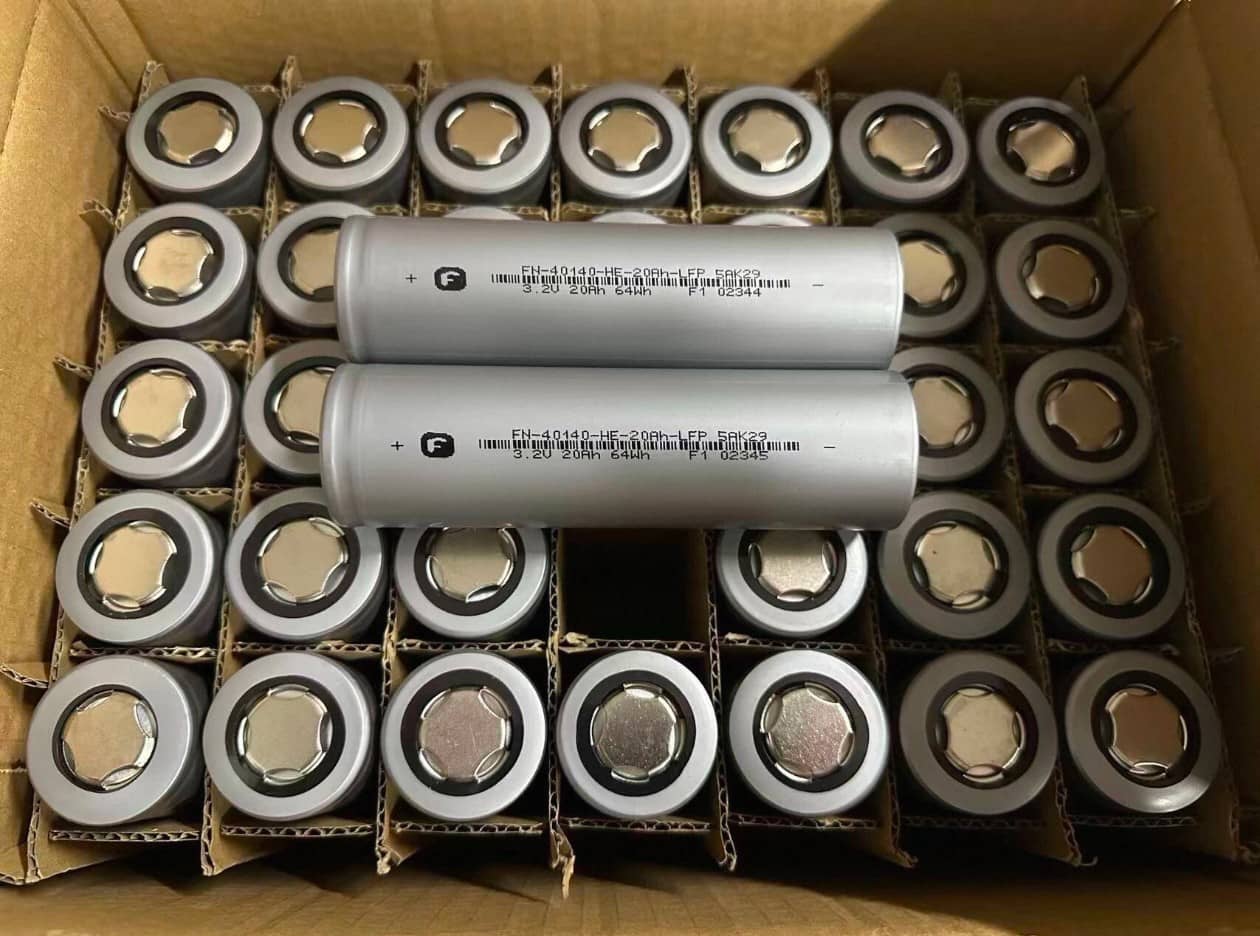
Cylindrical cells are wound electrode assemblies — a long strip of anode, separator, and cathode material rolled into a tight spiral ("jellyroll") and inserted into a cylindrical metal can. The format is the oldest in the lithium battery industry.
The naming convention encodes dimensions: "18650" = 18mm diameter x 65mm length. The "IFR" prefix on LFP cylindrical cells indicates Iron (Fe) chemistry.
Why cylindrical cells are safe: The cylindrical geometry distributes internal pressure uniformly across the full can surface — a passive safety advantage. If gas pressure builds during a fault event, the round can handles the load evenly rather than creating stress concentrations that could cause case rupture. Most cylindrical cells also include a current interrupt device (CID) and positive temperature coefficient (PTC) element that physically disconnect the cell at overpressure and overcurrent conditions.
Cylindrical cell advantages:
- Most mature manufacturing technology — highest automation level, tightest quality control
- Consistent cell-to-cell performance within a batch
- Excellent thermal management — small diameter means short thermal pathways to the can surface
- Highly resistant to vibration — compact size and rigid metal case resist mechanical damage
- Multiple independent safety mechanisms in each cell (CID, PTC, pressure vent)
Cylindrical cell limitations:
- Low individual capacity requires large cell counts (a 12V/100Ah bank from 32700 cells needs 67+ cells minimum)
- Round cells create unavoidable air gaps in rectangular pack space (~60-70% volume utilization)
- Large cell count means proportionally more weld joints, sense wires, and BMS complexity
- Not practical for DIY large-format (>10 kWh) energy storage
1.2 Prismatic LiFePO4 Cells
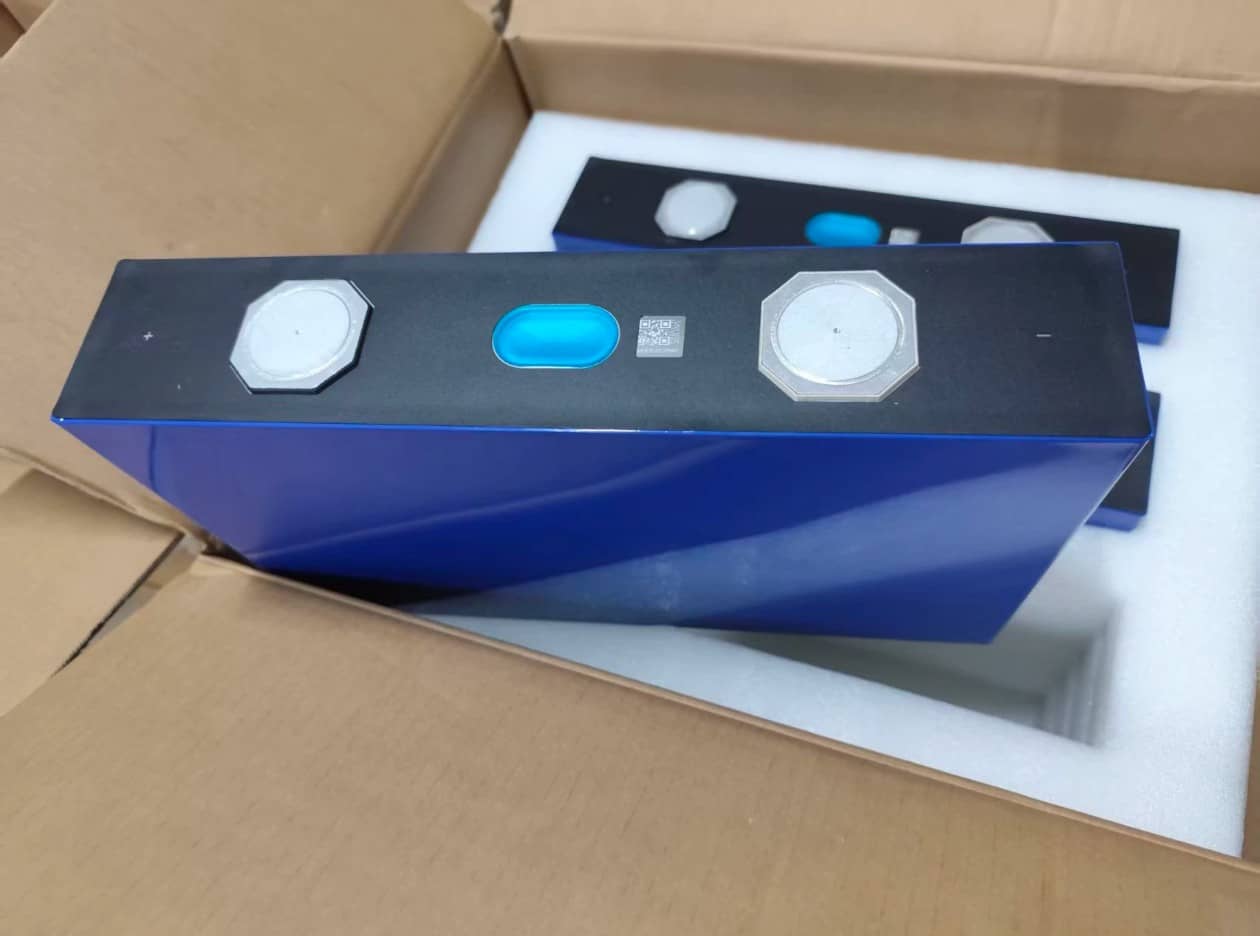
Prismatic cells use a flat stacked electrode architecture — alternating layers of anode, separator, and cathode in a rectangular aluminum case with threaded terminal posts on top. This format dominates large-format energy storage and commercial EV applications.
Two distinct prismatic sub-formats:
Standard prismatic (flat rectangular): The workhorse of DIY solar, residential BESS, and commercial storage. Typically 50Ah to 340Ah. Aluminum case provides rigid structural support; threaded M6 posts allow simple busbar connections without specialized welding.
Blade format (long, thin prismatic): BYD's proprietary innovation — an extremely elongated prismatic cell (965mm long x 90mm tall x 14mm thick) that functions simultaneously as a cell and structural pack element. More on this in Part 2.
The 280Ah and 314Ah cells are the current market workhorses for DIY solar and residential storage. A 16-cell 48V/280Ah bank delivers ~14.3 kWh of nameplate capacity. The 314Ah cell offers 12% more capacity in essentially the same footprint as the 280Ah — the better value per kWh for new builds.
Prismatic cell advantages:
- High individual capacity dramatically reduces cell count (16 cells = a full 48V/280Ah bank)
- Simple series wiring via aluminum busbars — no specialist welding required
- High volumetric efficiency (~72% packing density in rectangular enclosures)
- Fewer cells = simpler BMS management, fewer voltage taps, easier balancing
- 314Ah cells approach 1 kWh each — enabling very compact high-capacity systems
Prismatic cell limitations:
- Requires external compression structure — LFP prismatic cells expand 2-4% over their cycle life; without physical compression bands or a rigid enclosure, this causes cell delamination and premature capacity loss
- Less inherent thermal management than small cylindrical cells
- Corner and edge damage from mishandling is harder to detect than cylindrical case dents
- Individual cell failures are proportionally more impactful (1 of 16 cells vs. 1 of 600+ in a cylindrical pack)
1.3 Pouch LiFePO4 Cells
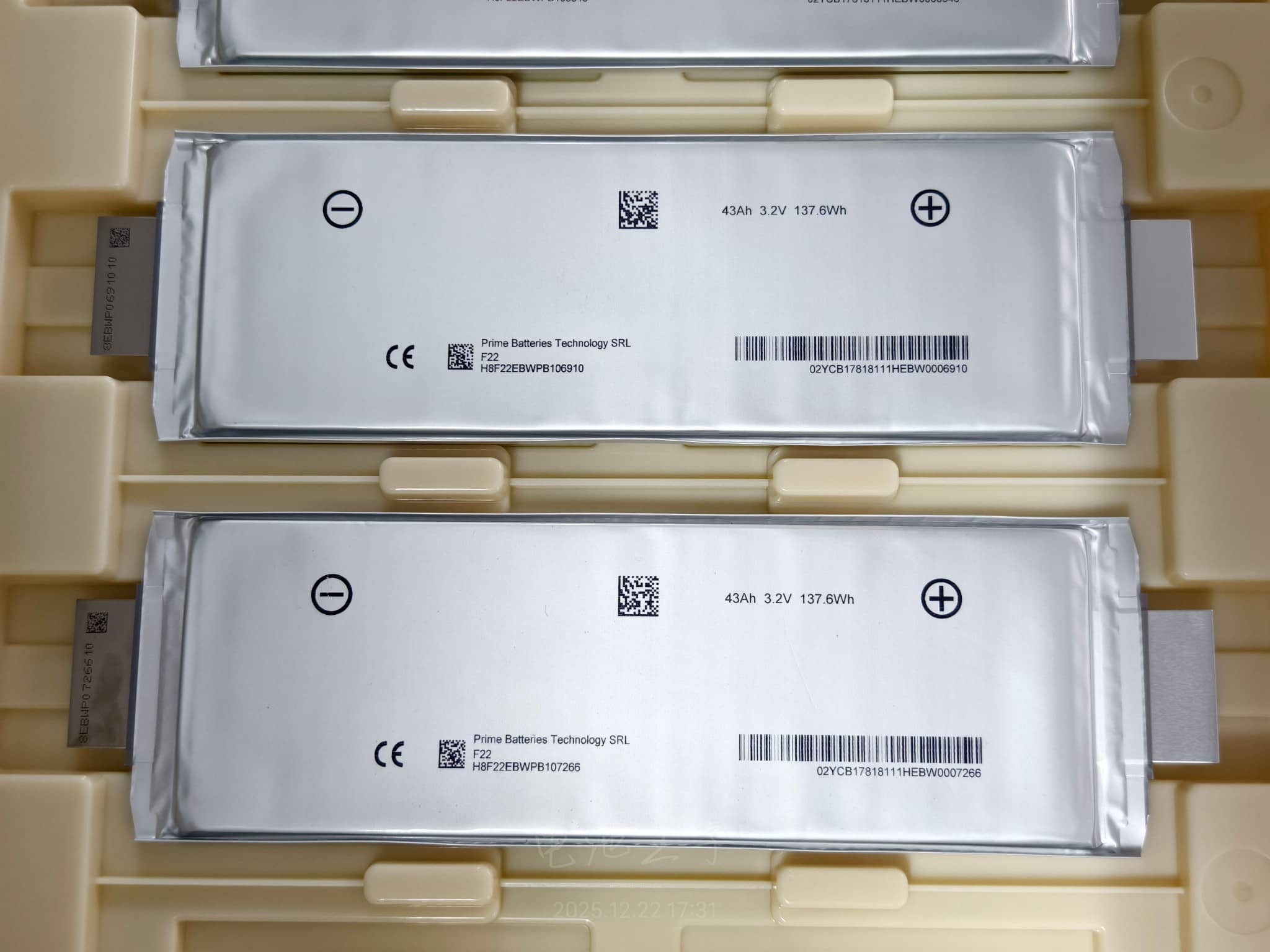
Pouch cells encase the stacked electrode assembly in a flexible laminated aluminum-polymer foil pouch, heat-sealed around the edges, with flat aluminum or nickel tab terminals. There is no rigid metal case.
Key characteristics:
- Nominal voltage: 3.2V (same LFP chemistry)
- Energy density: Highest gravimetric density of the three formats (~160-200 Wh/kg for LFP pouch) because no mass is devoted to a rigid case
- Capacity range: From a few hundred mAh (wearables) to 47+ Ah (automotive, e.g., BYD 47.7Ah LFP pouch cell)
- Customization: Can be manufactured in virtually any planar shape — rectangular, L-shaped, curved
The pouch cell swelling issue: Without a rigid case, pouch cells must be mechanically compressed during assembly to prevent swelling as gas evolves during cycling. The compression force also ensures proper contact pressure between electrode layers. This is the defining engineering challenge of pouch cell pack design — and why pouch cells are primarily an OEM format rather than a DIY option.
Pouch cell advantages:
- Highest energy density per gram — critical for aerospace, wearables, drones, performance applications
- Fully customizable form factor for OEM integration
- No heavy metal case weight penalty
- External swelling is visible as a warning signal before catastrophic failure
Pouch cell limitations:
- Requires sophisticated external compression structure — non-trivial engineering
- Less robust to mechanical damage and puncture than metal-cased formats
- More temperature-sensitive than rigid-case formats
- Primarily an OEM format — not practical for most DIY applications
Part 2: C-Rate Classifications — Understanding Power vs. Energy Cell Design
The second major axis of LiFePO4 battery classification is the C-rate — the rate at which a battery safely charges or discharges expressed as a multiple of its rated capacity. C-rate reflects fundamental cell design choices: electrode thickness, particle size, electrolyte formulation, current collector design. High C-rate capability requires thinner electrodes, smaller active material particles, and lower internal resistance — all of which trade off against energy density.
C-rate categories and design implications
1C — Standard Energy Storage Grade
The baseline for residential solar, RV, marine house battery, and off-grid storage. At 1C, a 100Ah cell delivers 100A continuous for one hour.
- Design: Optimized for maximum energy density; thicker electrodes, larger particle sizes
- Thermal behavior: Minimal heat generation — within passive air cooling limits
- Applications: Home BESS, solar storage, RV/marine house batteries, backup power
- Cycle life: Highest — energy-grade cells at 1C achieve the full rated cycle count (3,000-7,000+ cycles)
- BMS setting: Charge/discharge current limit typically set at or below 1C
2C-3C — High Power Grade
Optimized for applications requiring higher sustained current relative to cell size.
- Design: Thinner electrodes, higher-surface-area active materials, lower internal resistance at the cost of slightly reduced energy density
- Thermal behavior: Moderate heat at 2C; significant heat at 3C — active cooling beneficial for sustained operation
- Applications: Golf carts, AGVs, light electric vehicles, power-intensive marine propulsion, high-draw inverter systems
- Cycle life: Begins to decline vs. 1C cells when sustained at full 2C+ rate
5C and Higher — EV and High-Power Grade
Designed for burst power, rapid acceleration currents, or fast charging.
- Design: Fundamentally different electrode architecture — very thin electrodes, nano-scale active material particles, highly conductive electrolyte additives; energy density is meaningfully lower than 1C cells at the same physical size
- Thermal behavior: Significant heat generation; active liquid cooling typically required
- Applications: EV packs with regenerative braking, UPS systems, starter/cranking applications
- System requirement: The entire system must be rated for high current — BMS, busbars, connectors, and cabling must all be specified for the peak current demand. A 5C cell rating paired with an undersized BMS or inadequate wiring creates a dangerous bottleneck.
C-rate selection guide by application
| Application | Recommended C-Rate | Reasoning |
|---|---|---|
| Residential solar / home BESS | 0.5C-1C | Daily cycling at low current; maximize cycle life |
| RV / marine house battery | 0.5C-1C | Moderate loads; occasional high-draw managed by inverter sizing |
| Trolling motor battery | 1C-2C | Sustained motor current; occasional bursts |
| Golf cart / low-speed EV | 2C-3C | Sustained traction current with acceleration demands |
| Electric forklift | 2C-5C | High sustained current; rapid opportunity charging |
| Electric bus / commercial EV | 1C-3C | Large pack size limits effective C-rate; TMS critical |
| UPS / backup power | 0.5C standby / 5C+ discharge | Standby at low rate; fast full discharge when activated |
| Power tools | 3C-10C | Short burst discharge at very high rates |
Part 3: Application-Specific LiFePO4 Battery Types
Beyond cell format and C-rate, the market has developed application-specific LiFePO4 configurations that integrate cells, BMS, enclosure, and communication hardware into purpose-built systems.
3.1 Modular / Rack-Mount LiFePO4 Batteries
Pre-assembled battery units in standardized form factors (typically 48V/100Ah in 19-inch rack format) designed to stack in parallel for scalable capacity. Each module includes cells, integrated BMS, communication ports (RS485/CAN), and display electronics.
How they scale: Standard units (~5.12 kWh each) stack in parallel. Most systems support 8-16 units per string, allowing 5-80+ kWh from a single inverter. Multiple strings can be paralleled for larger installations.
Communication capability: Modular systems communicate with compatible inverters via RS485 or CAN bus — enabling real-time SoC reporting, temperature monitoring, charge/discharge commands, and coordinated cell balancing across multiple modules.
Best for: Residential solar above 10 kWh, commercial solar installations, microgrids, and any application needing scalability beyond what a single battery provides, or inverter-BMS closed-loop communication.
3.2 Residential / Wall-Mount LiFePO4 Batteries
Self-contained home energy storage units (typically 5-20 kWh) in aesthetically designed enclosures for wall or floor mounting. All hardware is integrated — cells, BMS, thermal management, display, and communication — in a single sealed unit.
Design philosophy: Prioritize integration simplicity, aesthetics, and safety certifications (UL 9540, UL 9540A, IEC 62619) over maximum energy density or lowest cost per kWh. Sealed enclosure means no DIY cell access.
Best for: Homeowners wanting a complete, warrantied solution with professional installation support, smart home integration, and full regulatory compliance certifications.
3.3 High-Rate / Power LiFePO4 Batteries
Pre-assembled battery packs using high-rate (2C-5C) cells, explicitly sized and rated for sustained high-current applications.
Key distinguishing feature: The BMS, internal busbars, terminals, and cells are all specified for the peak current output — not just the cell capacity number. A high-rate 100Ah battery at 3C is genuinely rated for 300A continuous discharge throughout the entire system.
Best for: Forklifts, electric cleaning machines, AGVs, golf carts, large off-grid inverter systems with simultaneous heavy loads.
3.4 Specialty / Extreme-Environment LiFePO4 Batteries
Engineered for operating conditions outside the standard -20°C to 60°C range, or unusual environmental conditions.
Cold-climate variants: Include BMS-controlled self-heating elements that warm cells above 0°C before allowing charge current. Without self-heating, LFP cells experience lithium plating during sub-zero charging — permanent, irreversible capacity loss with each occurrence. Self-heating is not a luxury feature in cold climates; it is a lifespan requirement.
High-temperature variants: Use modified electrolyte formulations and higher-temperature separators for stable performance in environments reaching 55-70°C ambient — industrial settings, desert solar installations.
Marine-rated variants: Include sealed IP67+ enclosures, stainless steel hardware, and BMS configurations optimized for the dual demands of marine house batteries (sustained low-current electronics loads, intermittent high-current windlass and bow thruster draws).
Part 4: Common Mistakes When Choosing a LiFePO4 Battery Type
Mistake 1 — Choosing format before application
The most common error. Selecting 280Ah prismatic cells and then trying to fit them into a 12V system, or buying cylindrical cells for a 30 kWh home battery (requiring 5,000+ cells). System voltage, required capacity, and physical space constraints must be defined before cell format is chosen.
Mistake 2 — Ignoring C-rate requirements
Using 1C energy-storage cells in a high-draw application pushes cells beyond rated current. The BMS typically responds by cutting off power — experienced as sudden loss under load. Repeated events degrade the cells and reduce cycle life significantly.
Mistake 3 — Skipping compression for prismatic builds
Prismatic LFP cells expand 2-4% over their cycle life. A pack assembled without compression bands or a rigid compression enclosure will experience cell delamination, tab stress, and premature capacity loss. Compression is not optional.
Mistake 4 — Mixing cells in a series pack
Cells in series must be matched — same chemistry, same manufacturer, same capacity rating, ideally same production batch. Mismatched cells create chronic imbalance the BMS cannot fully correct; the weakest cell limits the entire pack.
Mistake 5 — Sizing for nominal voltage instead of actual voltage swing
A device rated for "12V" must tolerate 14.6V fully charged and 10V fully discharged for a 4S LFP pack. Devices with narrow input windows may fault at the top or bottom of this range. Always verify input voltage range covers the full battery swing before purchasing.
Frequently Asked Questions
What are the main types of LiFePO4 batteries?
LiFePO4 batteries are classified by two primary axes. By cell format: cylindrical (round wound cells in rigid metal cans — common sizes 18650, 26650, 32700), prismatic (flat stacked cells in rectangular aluminum cases — common capacities 100-314Ah), and pouch (flat stacked cells in flexible foil pouches). By C-rate: 1C energy storage grade, 2C-3C high-power grade, and 5C+ EV/high-rate grade. Application-specific integrated systems — rack-mount modular, residential wall-mount, specialty — combine these building blocks with BMS and enclosures for turnkey deployment.
What does C-rate mean for a LiFePO4 battery?
C-rate is the rate of discharge (or charge) expressed as a multiple of the battery's rated capacity. A 1C rate discharges a 100Ah battery at 100A in one hour. A 2C rate discharges at 200A in 30 minutes. C-rate reflects fundamental cell design trade-offs: high C-rate cells use thinner electrodes and smaller active material particles for lower internal resistance and faster ion transport, but generally have lower energy density. Matching C-rate to application requirements is critical — 1C cells in high-current applications cause BMS cutoffs and degraded cycle life.
Can you use different LiFePO4 cell types in the same battery pack?
No. Cells in a series-connected pack must be identical — same chemistry, same capacity rating, same manufacturer, ideally same production batch. Mixing cell formats, capacities, or ages creates chronic state-of-charge imbalance that BMS balancing cannot fully correct. The weakest or most different cell limits the entire pack's discharge capacity and receives disproportionate stress at every cycle endpoint, accelerating its degradation and shortening the pack's overall service life.
What is a modular LiFePO4 battery and when should I use one?
A modular LiFePO4 battery is a pre-assembled, BMS-integrated unit (typically 48V/100Ah ~5.12 kWh) in a standardized rack-mount enclosure designed to be paralleled with additional modules for scalable total capacity. Multiple modules connect in parallel via communication bus (RS485 or CAN) to a compatible inverter. Modular systems are the right choice when: total capacity exceeds ~15 kWh, inverter-BMS communication is needed for system optimization, or when commissioning simplicity matters more than lowest cost per kWh.
Are pouch LiFePO4 batteries safe?
Yes, with appropriate engineering. Pouch cells have no rigid case to rupture under internal pressure — they swell instead, which is visible externally as a warning indicator. The safety profile differs from metal-cased formats: lower risk of violent case rupture, but higher susceptibility to mechanical damage and requirement for carefully engineered external compression. Pouch cells are not well-suited for DIY applications because the compression structure engineering is non-trivial. They are primarily specified by OEM engineers for consumer electronics, aerospace, military, and performance EV applications.
Conclusion
The LiFePO4 battery market in 2025 offers more format diversity than at any point in the technology's history — from sub-gram wearable pouch cells to 432 Wh BYD Blade cells serving simultaneously as battery and vehicle structure. Each format represents a genuine engineering answer to a specific set of application constraints.
The practical decision framework is straightforward: define your application's primary constraints (cell count tolerance, required current rate, weight budget, DIY complexity tolerance, operating temperature), then match those constraints to the format and C-rate category that best serves them.
For most DIY energy storage builders, that answer is large-format prismatic cells in a 48V/16S configuration. For most residential all-in-one buyers, it is a modular rack-mount system from a warrantied manufacturer. For applications requiring vibration resistance or high burst current in small packages, it is cylindrical cells.
The best battery is the one correctly specified for its job — not the one with the highest headline number.
- Next:3.2V LiFePO4 Battery: Complete Guide — Specs, Types, Applications (2026)
- Previous:Lithium-Ion Battery Weight and Energy Density: Formulas, Data & Chemistry Comparison
Contact Details
Lithium LiFePO4 Batteries and Lithium LiFePO4 Cells Supplier - LiFePO4 Battery Shop
Contact Person: Miss. Elena Wang
WhatsApp : +8615263269227
Skype : +8615263269227
WeChat :15263269227
Email : info@lifepo4batteryshop.com
All Products
- TC Elcon Charger (0)
- Headway Lithium Battery (6)
- Blade Battery (10)
- Semi Solid State Battery (6)
- A123 Battery (6)
- Sinopoly Battery (7)
- GBS Battery (16)
- CALB Battery (25)
- Cylindrical Cell (11)
- Energy Storage System (0)
- Battery Management System (15)
- Sodium ion Battery Cell (4)
- Lithium Titanate Battery (22)
- Ternary Lithium Battery Cell (12)
- REPT Battery (10)
- BYD Battery (5)
- CATL Battery (15)
- Thunder Sky Winston Battery (26)
- EVE Battery (35)
- LiFePO4 Battery Cell (24)
Certification
Customer Reviews
- I have fond memories of our meeting in Shanghai with LiFePO4 Battery Shop Elena. Your company left a strong impression on me with its impressive growth and professionalism. We both value straightforwardness and honesty, which I believe are the most important qualities in any partnership. I am confident that we can build a successful collaboration based on these shared values. —— Robert from USA
- I've been working with LiFePO4 Battery Shop for years, and their reliability is unmatched. While other suppliers frequently change sales teams, LiFePO4 Battery Shop has consistently provided exceptional service with a stable team. Their commitment to quality and customer support truly sets them apart. —— Henry from Australia