
Blog
Portable Battery Charger vs Power Bank: What Is the Difference?
2026-09-13 | Calvin
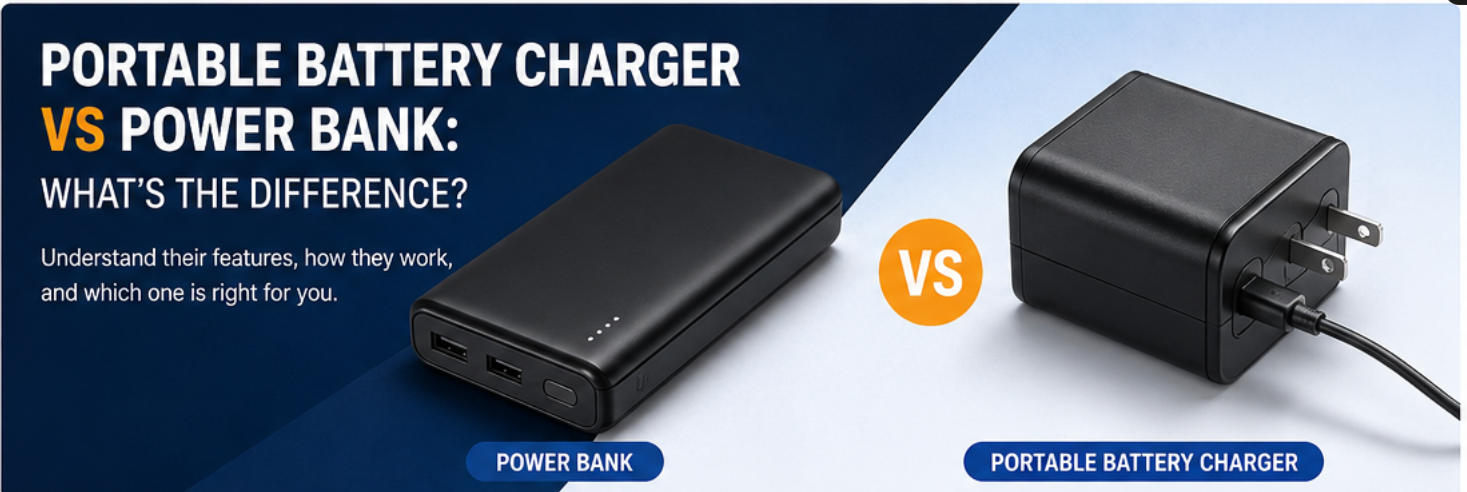
In everyday shopping, a portable charger and a power bank usually mean the same thing: a rechargeable battery that stores energy and charges your phone, tablet, earbuds, or laptop away from an outlet.
The confusion starts because “portable charger” is also used for compact wall adapters and chargers for removable batteries. Those products can be easy to carry, but they do not necessarily store power. A power bank always contains a battery. If a portable charger has its own rechargeable battery, it is a power bank.
This guide clears up the terminology, explains the specifications that matter, and helps you choose the right charging setup without paying for capacity or wattage you cannot use.
Contents
- The quick answer
- What each term means
- Key differences
- Capacity and recharge estimates
- Charging speed and compatibility
- How to choose
- Safety and air travel
- Frequently asked questions
Portable Charger vs Power Bank: Quick Answer
A power bank stores electricity in an internal battery and works when no outlet is available. A wall charger converts electricity from an outlet and stops working when it is unplugged. The phrase portable charger can describe either product, so check whether the item actually contains a battery.
| Feature | Power bank | Compact wall charger | Removable battery charger |
|---|---|---|---|
| Stores energy | Yes | No | Usually no |
| Works away from an outlet | Yes | No | Only if it also contains a battery |
| Main job | Carry stored power | Convert outlet power for a device | Charge loose cells or a battery pack |
| Common ratings | mAh, Wh, and W | W and supported output profiles | Battery chemistry, voltage, and charge current |
| Typical use | Travel, commuting, field work, emergencies | Home, office, hotel, and airport outlets | Cameras, tools, radios, and specialty equipment |
Choose a power bank when you need energy away from an outlet. Choose a wall charger when low weight and fast charging from available outlets matter more. Many people need both.
What Is a Power Bank?
A power bank is a rechargeable battery pack with control electronics and one or more power outputs. You charge the power bank first. It stores that energy, then releases it when another device is connected.
Most consumer power banks use lithium ion cells or lithium polymer pouch cells. The enclosure also contains charging controls, voltage conversion, temperature monitoring, and protection against conditions such as excessive current, short circuit, overcharge, and excessive discharge. Larger or more advanced packs may use a dedicated battery management system.
What happens inside a power bank?
- Input power charges the internal cells.
- The control circuit monitors cell voltage and temperature.
- A converter changes the cell voltage to the output requested by the connected device.
- The phone, tablet, or laptop controls how much power it accepts.
This final point matters. A power bank does not force its maximum wattage into a device. Compatible devices and chargers negotiate an appropriate output. The charging result is limited by the weakest part of the chain, which may be the power bank, cable, port, or device.
What Is a Portable Battery Charger?
Portable battery charger is a broad and inconsistent product term. Sellers may use it for three different products.
- A battery powered portable charger: This is another name for a power bank.
- A compact wall charger: This plugs into an outlet and contains no energy storage.
- A charger for removable batteries: This charges cells or battery packs used in cameras, tools, radios, vehicles, and industrial equipment.
Do not rely on the product name alone. Read the specifications. If the listing includes battery capacity in mAh or Wh, the charger probably stores energy. If it lists only input voltage, output wattage, and plug type, it is probably an adapter that needs an external source.
Key Differences That Affect Daily Use
Energy storage
This is the decisive difference. A power bank carries stored energy. A wall charger does not. A 65 W wall charger may refill a laptop quickly beside an outlet, yet it is useless during a train ride or power outage. A 65 W power bank can keep working anywhere until its internal battery is empty.
Weight and size
A wall charger only needs conversion electronics, so it is generally lighter than a power bank with the same maximum output. A power bank must carry cells, protection hardware, and an enclosure strong enough for mobile use. Higher capacity usually means more weight.
Charging time
A wall charger is ready whenever a suitable outlet is available. A power bank must be recharged after use. Check both its output power and its input power. A model that can send 100 W to a laptop but accepts only 18 W when recharging may take much longer to refill than expected.
Service life
A quality wall charger can last for years because it has no battery to age. A power bank gradually loses capacity through calendar aging, heat, and charge cycles. Plugging it in does not automatically use a complete cycle. Several partial charges can add up to one equivalent full cycle.
Use during a power cut
A power bank is useful during an outage because its energy is already stored. A wall charger only becomes useful when electricity returns or when it is connected to another live source, such as a generator or portable power station.
Cost
A power bank normally costs more than a wall charger with similar output because it includes battery cells and additional protection. Price should be compared against usable energy, sustained output, port selection, warranty, and safety documentation, not capacity alone.
How Power Bank Capacity Really Works
Power bank capacity is often printed in milliamp hours, or mAh. That number measures electric charge, not energy by itself. Voltage is also required. This is why watt hours provide a clearer basis for comparing batteries that use different voltages.
Watt hours = amp hours × voltage
To convert mAh to Ah, divide by 1,000. A 10,000 mAh power bank with a nominal cell voltage of 3.7 V stores about 37 Wh:
10,000 ÷ 1,000 × 3.7 = 37 Wh
The USB output will deliver less than the full 37 Wh. Some energy is lost in voltage conversion, the cable, charging electronics, and heat. The power bank also stops discharging before the cells reach a damaging voltage. Actual results vary with output level, temperature, product quality, and battery age.
How many phone charges will you get?
Compare energy in Wh rather than dividing one mAh number by another. Suppose a phone battery is rated at 5,000 mAh and 3.85 V. Its nominal energy is about 19.25 Wh. If a 37 Wh power bank delivers 70 to 85 percent of its stored energy after all losses, it may provide roughly 1.3 to 1.6 complete charges under favorable conditions.
Real use can be lower because the phone consumes power while charging. Wireless charging usually adds more loss and heat than a wired connection.
Common capacity ranges
| Rated capacity | Typical role | What to consider |
|---|---|---|
| 5,000 mAh | Emergency top up for one phone | Easy to carry, limited reserve |
| 10,000 mAh | Daily commuting and short trips | Good balance of capacity and weight |
| 20,000 mAh | Travel, several devices, or some laptops | Check output wattage and airline rules |
| 25,000 mAh or more | Laptop work and longer periods away from power | Heavier, slower to refill, and potentially subject to travel limits |
A large capacity does not guarantee fast charging. Capacity tells you how much energy is available. Wattage tells you how quickly the product can deliver it.
Charging Speed, Ports, and Compatibility
Check watts, not marketing labels
A charger rated at 20 W may be suitable for a phone. Many tablets and lightweight laptops benefit from 30 W to 65 W. Larger laptops may require 100 W or more. These are general ranges. The correct figure comes from the device maker.
The USB Implementers Forum states that the current USB Power Delivery specification can support power levels up to 240 W through a suitable full feature USB C cable and connector. That ceiling does not mean every USB C port provides 240 W. The power source, cable, and receiving device must all support the required profile.
Read the per port output
A power bank advertised at 100 W may provide that output through one port only. When two or three devices are connected, the total can be divided among the ports. For example, the main port may fall from 100 W to 65 W while a second port supplies 20 W. Check the output table in the manual for every port combination you expect to use.
Use the right cable
A cable can quietly limit charging speed. Confirm the connector, current rating, supported power, and data requirements. A cable intended for basic phone charging may not support a laptop at the power bank's maximum output.
Fast charging requires a shared protocol
USB Power Delivery is widely used, but brands may also support proprietary charging systems. If the power bank and phone do not share the same protocol, charging usually falls back to a lower common power level. Confirm compatibility by exact device model rather than assuming every fast charger works at full speed.
Wireless and magnetic power banks
A wireless power bank removes the cable between the bank and phone, which is convenient during short trips. The tradeoff is usually more heat and lower energy efficiency than a wired connection. Alignment matters, especially with a thick case or a phone that does not have matching magnets.
Choose a certified wireless model that matches the charging standard supported by your phone. Treat the wireless wattage and wired USB C wattage as separate specifications.
Can a power bank charge and recharge at the same time?
Some models support pass through charging, but many do not. Even when the feature is available, output may be reduced and extra heat may shorten battery life. Do not assume a power bank can replace an uninterruptible power supply. Use this mode only when the manufacturer explicitly supports it.
Which One Should You Choose?
Choose a power bank when:
- You spend hours away from an outlet.
- You need emergency power for a phone or hotspot.
- You travel by train, bus, or plane.
- You work in the field.
- You need to charge several devices from one stored energy source.
Choose a compact wall charger when:
- Outlets are normally available.
- You want the lightest possible travel kit.
- You need fast charging without carrying a battery.
- You want one adapter for a phone, tablet, and laptop.
- You do not need backup power during an outage.
Choose a dedicated battery charger when:
- You charge removable cells or a proprietary battery pack.
- The battery chemistry requires a specific charging profile.
- You need charge status, balancing, or storage mode for specialist equipment.
Five realistic buying scenarios
| Situation | Practical choice | Why it fits |
|---|---|---|
| Daily commute | 10,000 mAh phone power bank | Enough reserve for a long day without excessive weight |
| Two day business trip | Power bank plus compact wall charger | The bank covers travel time and the adapter refills devices at the hotel |
| Remote laptop work | USB C power bank with verified laptop output | Capacity and wattage are both matched to the computer |
| Photography assignment | Power bank plus dedicated camera battery charger | The bank supports phones and accessories while the correct charger handles removable camera batteries |
| Home and office use | Compact wall charger | Low weight and reliable outlet access make stored energy unnecessary |
Power bank buying checklist
- List the devices you will charge.
- Confirm the required input power for each device.
- Choose enough Wh for the number of recharges you need.
- Check output for one port and for every multiport combination.
- Confirm that the included or selected cable supports the required power.
- Check how quickly the power bank itself can recharge.
- Look for clear safety testing, manufacturer identity, warranty terms, and recall support.
- For air travel, make sure the Wh rating is printed clearly on the product.
Power Bank Safety and Air Travel Rules
Lithium battery products can overheat if they are damaged, poorly made, overcharged, exposed to water, or packed where the terminals can short circuit. Buy from a traceable manufacturer and use the supplied instructions. Protection electronics reduce risk, but they cannot make a damaged battery safe.
Stop using a power bank if you notice:
- Swelling or a case that has changed shape
- Unusual heat during light use or storage
- Smoke, hissing, odor, leakage, or discoloration
- A cracked case, crushed corner, or damaged port
- Repeated shutdowns or unstable output
- A recall affecting the model or serial number
Do not puncture, open, crush, or continue charging a suspect unit. Move away from it if this can be done safely, keep people clear, and follow local emergency and disposal guidance. Recalled lithium products should not be placed in household rubbish or a normal recycling bin unless the recall instructions specifically permit it.
Safer daily use
- Keep the power bank away from direct sun, hot vehicles, water, and combustible clutter.
- Use a cable that is undamaged and rated for the required power.
- Do not cover the unit while it is charging.
- Keep metal objects away from exposed connectors.
- Do not use a swollen or recalled product.
- Follow the manufacturer's temperature and storage instructions.
Long periods of heat or very high state of charge can accelerate battery aging. If a power bank will sit unused, follow its manual and keep it in a cool, dry place.
Can you take a power bank on a plane?
In the United States, the Federal Aviation Administration requires power banks and other spare lithium batteries to remain in carry on baggage. They are not allowed in checked baggage. Battery terminals must be protected against short circuit.
The standard FAA limit for a rechargeable lithium battery is 100 Wh. With airline approval, a passenger may carry up to two larger spare batteries above 100 Wh and no more than 160 Wh each. Airlines may impose stricter quantity, storage, or use rules, so check the carrier before every trip.
To estimate the energy rating:
Wh = mAh ÷ 1,000 × nominal voltage
A 20,000 mAh bank rated at 3.7 V is about 74 Wh, which sits below the FAA 100 Wh threshold. Use the rating printed by the manufacturer because security staff may not accept an unlabeled or unclear product.
Portable Charger vs Power Bank: Final Verdict
If a portable charger contains a rechargeable battery, it is a power bank. If it needs an outlet, it is a wall charger or power adapter. One stores energy. The other converts energy while it is connected to a source.
For daily travel, a 10,000 mAh power bank is often the practical middle ground. For laptops, capacity is only half the decision. Confirm the required USB C output, protocol, cable rating, and sustained wattage. If outlets are easy to reach, a compact wall charger will be lighter and may charge faster. For the most flexible kit, carry one carefully chosen power bank and one compact wall charger that share the same cable standard.
Frequently Asked Questions
Is a portable charger the same as a power bank?
Usually, yes. Retailers commonly use both names for a rechargeable battery that charges devices away from an outlet. Portable charger can also describe a small wall adapter, so check whether the product has an internal battery.
Does a power bank need electricity?
It needs electricity to recharge its internal battery. Once charged, it can supply stored power without an outlet until its battery is depleted.
Is 10,000 mAh enough for a power bank?
It is enough for many commuters and short trips. It can often provide more than one full phone charge, but the exact result depends on the phone battery, conversion losses, temperature, and whether the phone is used while charging.
Can a 20,000 mAh power bank charge a laptop?
Capacity alone does not answer this. The bank must support the voltage, power, and protocol required by the laptop. A 20,000 mAh model with low output may charge phones well but fail to charge a laptop.
Can I use a phone while it charges from a power bank?
Yes, although heavy use can slow the charge and create more heat. Gaming, navigation, video calls, and maximum screen brightness can consume much of the incoming power.
Why does my power bank provide fewer charges than the mAh calculation suggests?
The printed mAh figure describes the internal cells at their nominal voltage. Energy is lost when voltage is converted and when the phone battery charges. Cable resistance, heat, battery age, and phone use reduce the result further.
Is wired charging better than wireless charging?
Wired charging is usually more energy efficient and often faster. Wireless charging is convenient and reduces cable handling. The better choice depends on whether you value maximum usable capacity or simple attachment.
How long does a power bank last?
There is no single lifespan. Cell chemistry, heat, charging behavior, cycle count, storage, and product quality all matter. Replace the unit when capacity becomes inadequate or when it shows swelling, unusual heat, damage, unstable output, or a relevant recall.
What is the difference between lithium ion and lithium polymer power banks?
Both are rechargeable lithium battery technologies. Lithium polymer pouch cells allow thin and flexible pack shapes, while cylindrical lithium ion cells use a rigid metal case. Product design and cell quality matter more to a buyer than the label alone.
- Next:Nature Publishes Landmark Study: Dynamic Discharge Boosts Battery Life by 38%
- Previous:UAV vs FPV Drone: What Is the Difference?
Contact Details
Lithium LiFePO4 Batteries and Lithium LiFePO4 Cells Supplier - LiFePO4 Battery Shop
Contact Person: Miss. Elena Wang
WhatsApp : +8615263269227
Skype : +8615263269227
WeChat :15263269227
Email : info@lifepo4batteryshop.com
All Products
- Forklift Battery Charger (0)
- TC Elcon Charger (5)
- Headway Lithium Battery (6)
- Blade Battery (10)
- Semi Solid State Battery (6)
- A123 Battery (6)
- Sinopoly Battery (7)
- GBS Battery (20)
- CALB Battery (26)
- Cylindrical Cell (14)
- Energy Storage System (0)
- Battery Management System (15)
- Sodium ion Battery Cell (4)
- Lithium Titanate Battery (23)
- Ternary Lithium Battery Cell (12)
- REPT Battery (10)
- BYD Battery (5)
- CATL Battery (15)
- Thunder Sky Winston Battery (26)
- EVE Battery (39)
- LiFePO4 Battery Cell (40)
Certification
Customer Reviews
- I have fond memories of our meeting in Shanghai with LiFePO4 Battery Shop Elena. Your company left a strong impression on me with its impressive growth and professionalism. We both value straightforwardness and honesty, which I believe are the most important qualities in any partnership. I am confident that we can build a successful collaboration based on these shared values. —— Robert from USA
- I've been working with LiFePO4 Battery Shop for years, and their reliability is unmatched. While other suppliers frequently change sales teams, LiFePO4 Battery Shop has consistently provided exceptional service with a stable team. Their commitment to quality and customer support truly sets them apart. —— Henry from Australia