
Blog
Nominal Capacity vs Rated Capacity of Lithium Batteries: What Is the Difference?
2026-08-24 | Calvin
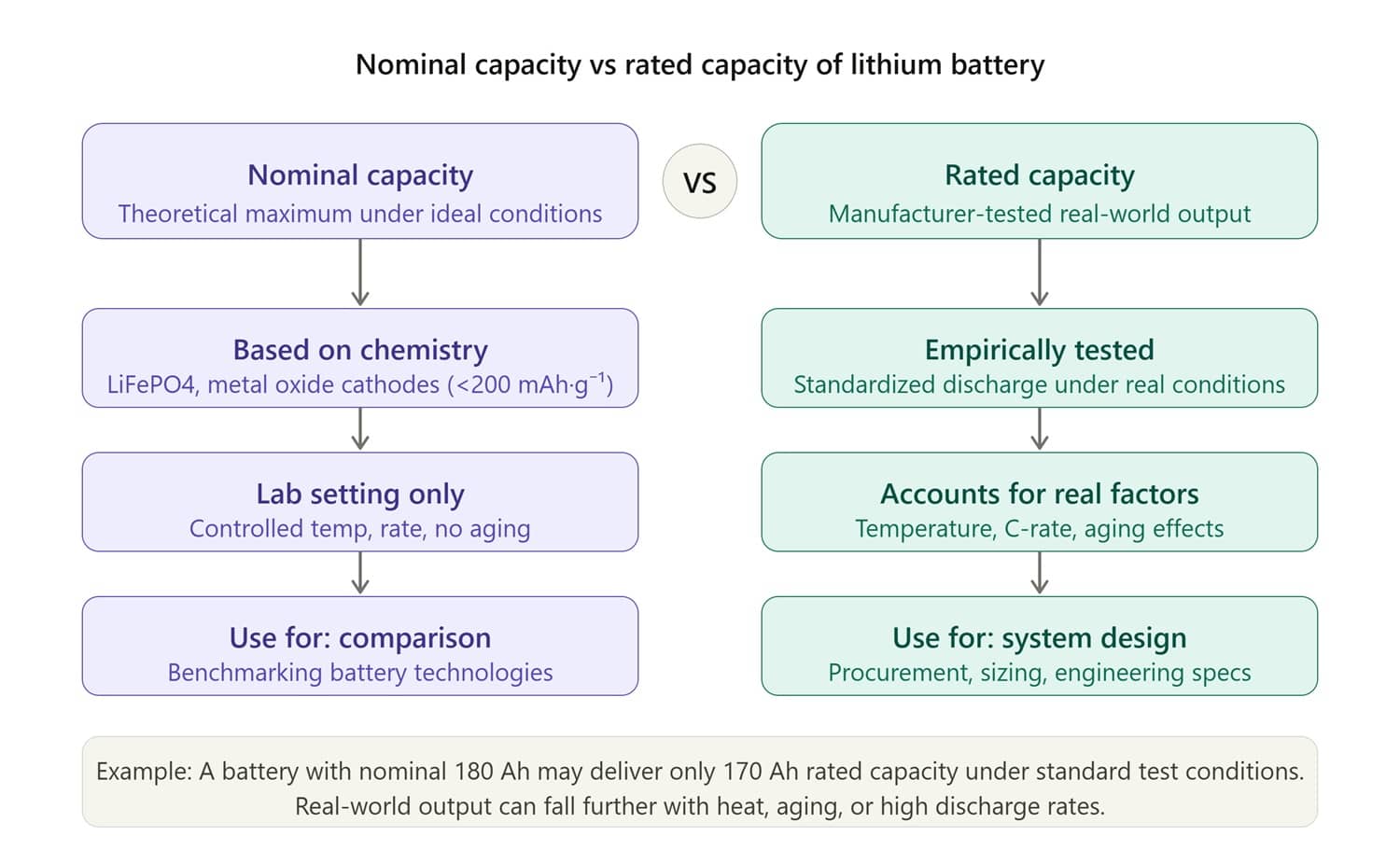
Nominal capacity and rated capacity both describe how much charge a lithium battery can deliver, but they are not always interchangeable. The practical difference comes down to how the manufacturer defines the number, the conditions used to test it, and whether the value is typical, declared, or guaranteed as a minimum.
The most important point is simple. Nominal capacity is not automatically a theoretical chemical maximum, and rated capacity is not automatically the capacity you will receive in every application. Both values need test conditions before they can support a reliable comparison.
Nominal Capacity vs Rated Capacity: The Quick Answer
Nominal capacity is commonly the capacity value used to identify and describe a battery model. It is a reference value stated by the manufacturer and applies under defined conditions.
Rated capacity is the capacity declared by the manufacturer for specified reference conditions. Depending on the data sheet and the applicable standard, it may function as a verified value or a conservative value used for compliance and comparison.
Actual capacity is the charge measured from an individual cell or battery during a specific test.
Usable capacity is the portion your system permits you to access after battery management limits, voltage cutoffs, reserve settings, and operating conditions are considered.
Terminology varies among manufacturers. If nominal capacity and rated capacity both appear on a data sheet, do not assume one definition from the label alone. Read the test notes, discharge current, temperature, charge procedure, final discharge voltage, and minimum capacity statement.
What Does Lithium Battery Capacity Mean?
Battery capacity describes the amount of electric charge a fully charged battery can release before it reaches a defined final voltage. It is normally expressed in ampere hours, written as Ah, or milliampere hours, written as mAh.
One ampere hour means one ampere of current flowing for one hour. In a simple constant current test:
Capacity in Ah = discharge current in A × discharge time in hours
A 100 Ah battery could theoretically supply 10 A for 10 hours. That does not mean it will always supply 100 A for one hour. Higher current increases voltage drop and heat, and the battery management system may stop the discharge before all listed capacity is available.
Capacity in Ah also does not tell you the complete energy content unless voltage is known. For a quick comparison:
Energy in Wh ≈ nominal voltage × capacity in Ah
A 3.2 V, 100 Ah LiFePO4 cell contains about 320 Wh of nominal energy. A 51.2 V, 100 Ah battery contains about 5,120 Wh, or 5.12 kWh. The two batteries share the same Ah value, but the second stores far more energy because its voltage is higher.
What Is Nominal Capacity in a Lithium Battery?
Nominal capacity is the capacity value assigned to a battery for identification and performance reference. Manufacturers commonly place it in a product name, data sheet, label, or sales description. A cell sold as a 100 Ah LiFePO4 cell will often list 100 Ah as its nominal capacity.
The word nominal means named or stated. It does not, by itself, mean a theoretical limit calculated from electrode chemistry. The electrochemical materials determine what a cell design can achieve, but the nominal capacity shown for a finished battery is normally linked to a defined discharge test.
For example, an LiFePO4 Battery Shop GBS 3.2 V 100 Ah LiFePO4 cell lists both nominal capacity and minimum capacity as 100 Ah. Its specifications also identify a standard discharge rate of 0.5C and an end of discharge voltage of 2.5 V. Those conditions give the capacity figure practical meaning.
Nominal capacity is useful for:
- Identifying the intended capacity category of a battery
- Calculating C rate current
- Estimating nominal energy
- Planning series and parallel pack configurations
- Comparing models when their test conditions are equivalent
It should not be used alone to promise runtime. Two batteries marked 100 Ah can deliver different usable energy if their voltage window, temperature, discharge rate, cell consistency, or battery management settings differ.
What Is Rated Capacity in a Lithium Battery?
Rated capacity is the capacity value declared by the manufacturer under specified reference conditions. The current European battery regulation defines rated capacity for relevant rechargeable batteries as the total ampere hours that can be withdrawn from a fully charged battery under reference conditions.
Those reference conditions commonly include:
- Charge current and final charge voltage
- Rest time after charging
- Discharge current or C rate
- Ambient or cell temperature
- Final discharge voltage
- Any conditioning cycles required before the test
Rated capacity can be equal to nominal capacity, or it can be lower than a typical capacity figure. It depends on the manufacturer and the standard being followed. For example, a Panasonic lithium ion specification lists a typical capacity of 32 mAh and a rated capacity of 30 mAh for one model. The lower rated figure gives designers a more conservative basis than the typical production result.
Rated capacity is therefore useful only when its conditions and tolerance are visible. A value tested at 0.2C and 25°C should not be treated as proof that the same capacity will be delivered at 2C in cold weather.
Nominal Capacity vs Rated Capacity at a Glance
| Point of comparison | Nominal capacity | Rated capacity |
|---|---|---|
| Primary purpose | Model identification and reference | Declared performance under reference conditions |
| Typical location | Product name, label, data sheet | Data sheet, compliance information, test report |
| Test conditions required | Yes, for a meaningful technical comparison | Yes, because the rating applies under stated conditions |
| Guaranteed minimum | Not necessarily | Sometimes, but the data sheet must say so |
| Relationship to typical capacity | May be equal, lower, or defined separately | Often equal to or below typical capacity |
| Best use | Initial comparison and pack calculations | Procurement and performance comparison under matched conditions |
The labels alone are not enough. A serious comparison should also include minimum capacity, usable energy, discharge rate, voltage limits, temperature, cycle life conditions, and battery management limits.
Nominal, Rated, Actual, and Usable Capacity Are Different
Actual capacity
Actual capacity is the measured result from a particular cell or battery. A new 100 Ah cell may test slightly above 100 Ah, exactly at 100 Ah, or below it. Whether the cell passes depends on the minimum requirement, measurement accuracy, and test procedure.
Actual capacity changes with age and use. State of health compares the battery's current capability with its initial reference capacity. A battery at 80 percent state of health can deliver about 80 percent of the reference capacity under comparable test conditions.
Typical capacity
Typical capacity represents a normal production result, not necessarily the minimum every unit will achieve. When both typical and minimum values are available, use the minimum value for conservative engineering unless the supply agreement states another acceptance limit.
Usable capacity
Usable capacity is what the application can access. It is often lower than total capacity because the battery management system reserves energy near the upper and lower voltage limits. This protects the cells, supports cycle life, and reduces the risk of overcharge or excessive discharge.
Available capacity
Available capacity is what remains under the conditions at that moment. Cold temperature, high current, cell imbalance, voltage sag, and aging can all reduce the energy available before the system reaches its cutoff.
Why Lithium Battery Test Conditions Matter
Discharge rate
Capacity is measured at a stated current. A rate of 0.5C on a 100 Ah battery is 50 A. A rate of 1C is 100 A. Higher discharge current usually causes greater voltage drop and heat. The battery may reach its cutoff earlier, particularly when internal resistance is high.
Temperature
Low temperature slows electrochemical reactions and raises effective resistance, which can reduce available capacity and power. High temperature may improve short term discharge performance, but repeated exposure can accelerate aging. A capacity value measured at 25°C should not be used without adjustment for a battery that will spend winter outdoors or operate beside hot equipment.
Voltage window
The final discharge voltage determines when a capacity test ends. A lower cutoff can produce a higher measured Ah result, but discharging beyond the manufacturer's limit can damage the cell. A battery management system may use a more conservative cutoff than the cell data sheet.
Charge procedure
A capacity test is valid only if the battery begins from the defined fully charged state. Charge voltage, current, termination current, temperature, and rest time can change the result. The charger must match the battery chemistry and manufacturer limits.
Age and state of health
Capacity fades through calendar aging and cycling. Heat, high state of charge, deep cycling, and demanding current profiles can increase the rate of decline. Cycle life claims must state the depth of discharge, C rate, temperature, and remaining capacity threshold.
Cell consistency and balancing
A battery pack stops charging or discharging when the first cell reaches a protection limit. One weak or poorly balanced cell can therefore reduce pack capacity even when most cells remain healthy. Capacity matching, internal resistance matching, thermal design, and an effective battery management system matter as much as the label on each cell.
How to Calculate Battery Capacity, Energy, and Runtime
Calculate capacity from a discharge test
For a constant current discharge:
Capacity in Ah = current in A × time in hours
If a battery supplies 20 A for 4.8 hours before reaching the specified cutoff:
20 A × 4.8 hours = 96 Ah
For a changing current, a battery tester calculates capacity by adding the current delivered across small time intervals.
Calculate nominal energy
Nominal energy in Wh = nominal voltage × nominal capacity
For a 51.2 V, 200 Ah LiFePO4 battery:
51.2 V × 200 Ah = 10,240 Wh = 10.24 kWh
This is a useful nameplate estimate. Precise discharged energy is calculated from voltage and current throughout the test because battery voltage changes during discharge.
Estimate runtime
Runtime in hours ≈ usable energy in kWh × system efficiency ÷ load in kW
Assume the battery provides 10 kWh of usable energy, the conversion system is 92 percent efficient, and the average load is 1.5 kW:
10 × 0.92 ÷ 1.5 = 6.13 hours
Real runtime can be shorter if the load has high starting current, the battery is cold, auxiliary equipment consumes power, or the system keeps an additional reserve.
How to Read a Lithium Battery Data Sheet Correctly
Use this order when comparing cells, modules, or complete battery systems:
- Identify the capacity label. Check whether the value is nominal, rated, typical, minimum, total, or usable.
- Find the test conditions. Record the charge method, discharge current, temperature, rest time, and final discharge voltage.
- Check the minimum value. Typical capacity describes an expected result. Minimum capacity is more useful for acceptance testing.
- Compare energy in Wh or kWh. Ah alone cannot compare batteries at different voltages.
- Confirm the usable voltage window. Cell limits and battery management limits may differ.
- Check continuous and peak current. Capacity does not prove that a battery can support the required power.
- Read the cycle life conditions. Look for depth of discharge, C rate, temperature, and the remaining capacity threshold.
- Confirm cell consistency. Ask about capacity spread, internal resistance spread, production date, grading, and traceability.
- Review safety and transport documentation. Certification requirements depend on the product and market, while UN 38.3 testing is central to lithium battery transport.
- Ask for a complete data sheet. A marketplace title or label is not enough for system design.
How to Choose the Right Lithium Battery Capacity
Start with the energy your equipment uses each day, not with a battery label.
- Add the energy consumption of each load in Wh or kWh.
- Account for inverter, wiring, and converter losses.
- Divide by the planned usable depth of discharge.
- Add a reserve for cold conditions, peak demand, and future capacity fade.
- Confirm that continuous and peak current remain within battery limits.
- Verify the calculation against the manufacturer's test conditions and warranty terms.
For example, a system that needs 4 kWh per day should not be designed around a 4 kWh nameplate battery. If 90 percent is usable, conversion efficiency is 92 percent, and a 15 percent operating reserve is required, the minimum nominal energy is:
4 ÷ 0.90 ÷ 0.92 × 1.15 = 5.56 kWh
The next suitable standard size would normally be selected, provided its current, voltage, temperature, and cycle life ratings also fit the application.
Frequently Asked Questions
Is nominal capacity the theoretical maximum capacity?
Not necessarily. In finished battery data sheets, nominal capacity is usually a named reference value for the product under stated conditions. The theoretical specific capacity of an electrode material is a different concept.
Is rated capacity always lower than nominal capacity?
No. It may be lower, equal, or defined differently. Some manufacturers publish typical capacity and a lower rated or minimum value. Others use nominal and rated capacity for the same declared value. The data sheet definition controls the comparison.
Which capacity should I use when designing a battery system?
Use the most conservative verified value available under conditions close to your application. Then calculate with usable energy and include allowances for efficiency, temperature, aging, and reserve requirements.
Why did my battery test below its listed capacity?
Common causes include an incomplete charge, high discharge current, low temperature, an early voltage cutoff, inaccurate test equipment, cell imbalance, or capacity fade. Repeat the test using the exact charge and discharge procedure in the data sheet.
What is the difference between Ah and Wh?
Ah measures electric charge. Wh measures energy and includes voltage. Use Wh or kWh when comparing batteries with different voltages or calculating equipment runtime.
Can a lithium battery deliver more than its nominal capacity?
Yes. A new cell can measure above its nominal capacity when production tolerance and test conditions allow it. That does not justify exceeding the stated voltage, current, or temperature limits.
Does a 100 Ah battery always provide 100 Ah?
No. The value applies under specified test conditions. Available capacity in service depends on current, temperature, cutoff settings, state of health, cell balance, and system losses.
How does capacity affect battery life?
Capacity decreases as a battery ages. Service life is usually evaluated by the number of cycles or years required for capacity to fall to a stated percentage of its initial reference value. The threshold and test conditions should be included with every cycle life claim.
Final Takeaway
The useful difference between nominal capacity and rated capacity is not that one is theoretical and the other is real. Both are manufacturer stated values whose meaning depends on defined conditions.
Nominal capacity usually identifies the battery's capacity category. Rated capacity declares performance under reference conditions. Actual capacity is measured from an individual battery, while usable capacity is the portion the system allows you to use.
For a reliable purchase, compare the complete data sheet. Match the capacity definition, discharge rate, temperature, voltage window, minimum value, usable energy, current limit, and cycle life conditions. That approach gives you a battery sized for the work it must perform, not simply the largest number printed on the label.
- Next:What Is a Battery Charge? Complete Guide to Battery Charging Process
- Previous:Understanding the Lithium Battery Cell Manufacturing Process
Contact Details
Lithium LiFePO4 Batteries and Lithium LiFePO4 Cells Supplier - LiFePO4 Battery Shop
Contact Person: Miss. Elena Wang
WhatsApp : +8615263269227
Skype : +8615263269227
WeChat :15263269227
Email : info@lifepo4batteryshop.com
All Products
- Forklift Battery Charger (0)
- TC Elcon Charger (5)
- Headway Lithium Battery (6)
- Blade Battery (10)
- Semi Solid State Battery (6)
- A123 Battery (6)
- Sinopoly Battery (7)
- GBS Battery (18)
- CALB Battery (26)
- Cylindrical Cell (14)
- Energy Storage System (0)
- Battery Management System (15)
- Sodium ion Battery Cell (4)
- Lithium Titanate Battery (23)
- Ternary Lithium Battery Cell (12)
- REPT Battery (10)
- BYD Battery (5)
- CATL Battery (15)
- Thunder Sky Winston Battery (26)
- EVE Battery (37)
- LiFePO4 Battery Cell (39)
Certification

Customer Reviews
- I have fond memories of our meeting in Shanghai with LiFePO4 Battery Shop Elena. Your company left a strong impression on me with its impressive growth and professionalism. We both value straightforwardness and honesty, which I believe are the most important qualities in any partnership. I am confident that we can build a successful collaboration based on these shared values. —— Robert from USA
- I've been working with LiFePO4 Battery Shop for years, and their reliability is unmatched. While other suppliers frequently change sales teams, LiFePO4 Battery Shop has consistently provided exceptional service with a stable team. Their commitment to quality and customer support truly sets them apart. —— Henry from Australia