
Blog
LiFePO4 Battery Temperature Range: What You Need to Know
2025-12-17 | Calvin
LiFePO4 (Lithium Iron Phosphate) batteries are highly regarded for their safety, long lifespan, and excellent energy density. However, like any battery technology, understanding the temperature range at which these batteries operate efficiently is crucial for ensuring optimal performance. In this article, we'll explore the ideal temperature range for LiFePO4 batteries and how temperature affects their performance.
What is the LiFePO4 Temperature Range?
The LiFePO4 temperature range refers to the environmental conditions under which the battery can function optimally. While the ideal operating range for these batteries is typically between -20°C and 40°C, this range applies mainly to discharge performance. Lithium-ion batteries, including LiFePO4, cannot be safely charged at temperatures below 0°C, which is a common limitation. To mitigate this, users often use battery heaters or store the battery in a temperature-controlled environment in colder conditions.
How Do LiFePO4 Batteries Perform at Different Temperatures?
The performance of a LiFePO4 battery is significantly influenced by temperature. The two main factors that users should consider are capacity and voltage, both of which can fluctuate depending on the surrounding temperature.
1. Battery Capacity
Capacity is one of the most critical performance indicators for any battery. For LiFePO4 batteries, capacity refers to the amount of energy the battery can store and deliver. As a general rule, the higher the capacity, the better—but larger capacities also come at a higher cost.
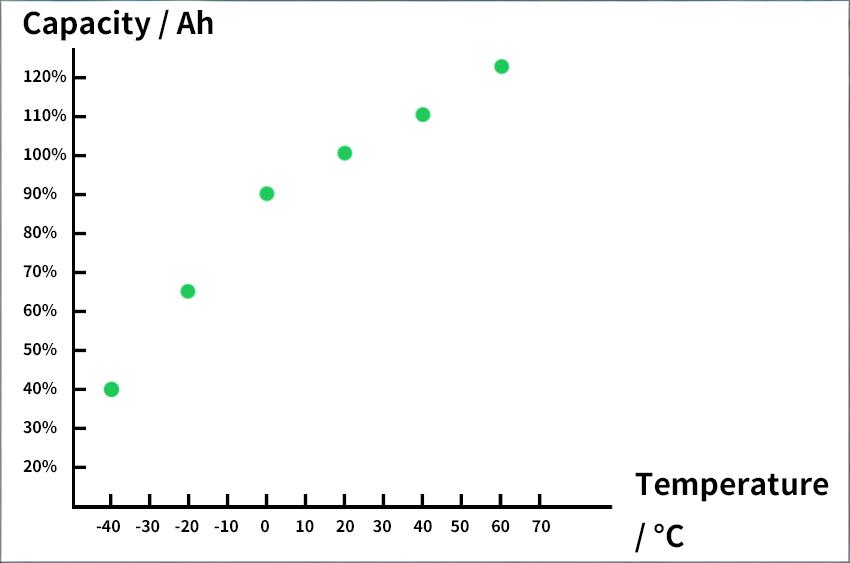
LiFePO4 batteries exhibit their best performance at temperatures above 10°C. At around 15°C, the battery reaches its rated capacity, while at 25°C (room temperature), it performs at slightly higher than the rated capacity. In fact, the battery's performance can improve slightly at higher temperatures. For example, at 40°C, a LiFePO4 battery may deliver up to 120% of its rated capacity.
Conversely, low temperatures lead to decreased battery performance. In extremely cold conditions (between -20°C and -40°C), the battery’s capacity may drop to 60%-40% of its rated value. This reduction is common across most battery types, but it is particularly pronounced in lithium-ion batteries, including LiFePO4.
2. Battery Voltage
While the nominal voltage of a LiFePO4 battery is generally 3.2V, it fluctuates depending on the temperature and state of charge (SOC). For instance, at 50% SOC, the voltage remains relatively stable between 3.2V and 3.3V across a broad temperature range (-20°C to 50°C). This stability is crucial for consistent power output and input.
However, when the battery is at a lower SOC, such as 15%, the voltage tends to fluctuate more significantly. At -20°C, the voltage may drop to around 3.0V, while it stabilizes around 3.2V at room temperature.
These fluctuations show that LiFePO4 batteries with a low SOC are more sensitive to temperature changes. For daily energy storage applications, these temperature-induced variations may not significantly impact performance. However, in demanding applications like electric vehicles (EVs), the degradation of performance due to temperature can be a substantial drawback.
Temperature’s Impact on LiFePO4 Battery Use Cases
For general energy storage purposes, temperature variations typically fall within an acceptable range. Energy storage systems do not frequently demand high power input or output, meaning the impact of temperature on battery performance is manageable.
However, for electric vehicles and other high-performance applications, temperature plays a more significant role. Cold weather can substantially affect battery performance, leading to reduced driving range and charging efficiency. As a result, battery heaters or thermal management systems are often used to mitigate the effects of extreme temperatures on EV batteries.
Conclusion
Understanding the LiFePO4 temperature range is essential for maximizing the lifespan and performance of your battery. While these batteries offer numerous advantages, such as high safety, long cycle life, and excellent energy density, performance can be affected by temperature fluctuations. By knowing how temperature influences capacity and voltage, you can optimize the use of LiFePO4 batteries for your specific needs—whether for energy storage, electric vehicles, or other applications.
- Next:The Principle of Lithium-Ion Battery Charging: A Comprehensive Guide
- Previous:How to Accurately Estimate the State of Charge (SOC) of LiFePO4 Batteries
Contact Details
Lithium LiFePO4 Batteries and Lithium LiFePO4 Cells Supplier - LiFePO4 Battery Shop
Contact Person: Miss. Elena Wang
WhatsApp : +8615263269227
Skype : +8615263269227
WeChat :15263269227
Email : info@lifepo4batteryshop.com
All Products
- Blade Battery (8)
- Semi Solid State Battery (6)
- A123 Battery (5)
- Sinopoly Battery (7)
- GBS Battery (16)
- CALB Battery (22)
- Cylindrical Cell (6)
- Energy Storage System (0)
- Battery Management System (2)
- Sodium ion Battery Cell (3)
- Lithium Titanate Battery (20)
- Ternary Lithium Battery Cell (11)
- REPT Battery (8)
- BYD Battery (2)
- CATL Battery (14)
- Thunder Sky Winston Battery (21)
- EVE Battery (29)
- LiFePO4 Battery Cell (4)
Certification
Customer Reviews
- I have fond memories of our meeting in Shanghai with LiFePO4 Battery Shop Elena. Your company left a strong impression on me with its impressive growth and professionalism. We both value straightforwardness and honesty, which I believe are the most important qualities in any partnership. I am confident that we can build a successful collaboration based on these shared values. —— Robert from USA
- I've been working with LiFePO4 Battery Shop for years, and their reliability is unmatched. While other suppliers frequently change sales teams, LiFePO4 Battery Shop has consistently provided exceptional service with a stable team. Their commitment to quality and customer support truly sets them apart. —— Henry from Australia