
Blog
How Long Does a 3.7V Lithium-Ion Battery Last? Lifespan, Cycles & Proven Maintenance Tips
2026-05-21 | Calvin
QUICK ANSWER
A standard 3.7V lithium-ion battery lasts 300–500 charge cycles or 2–5 years under typical use. Premium cells under ideal conditions reach 800–1,000 cycles. Keeping charge between 20%–80% is the single most effective way to extend lifespan — it can double usable cycle count.
- Typical Cycles: 300–500
- Calendar Life: 2–5 yrs
- Ideal Charge Range: 20–80%
- Safe Operating Temp: <45°C
3.7V lithium-ion cells power nearly every portable device in modern life — from phones to medical monitors, drones, and handheld tools. Most users, however, don't know how long they last or why they degrade. This guide explains aging mechanisms, runtime calculation, and evidence-backed maintenance tips.
SECTION 01: What Is a 3.7V Lithium-Ion Battery?
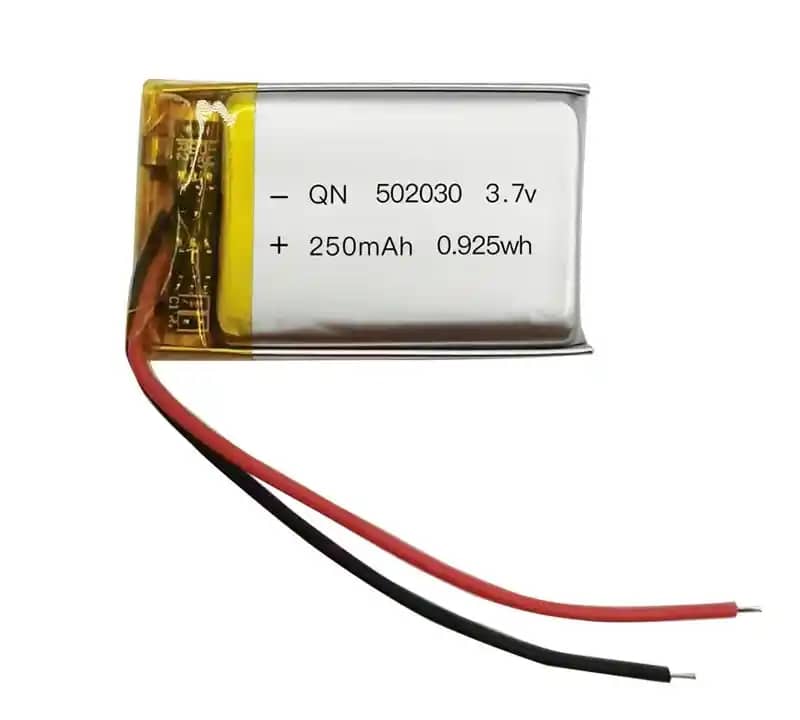
A 3.7V lithium battery is a single rechargeable cell with a nominal voltage of 3.6–3.7V — the average working voltage across its full discharge range.
Key Voltage Milestones
- Fully charged: ~4.2V (4.35V for high-voltage variants)
- Nominal (rated): 3.6–3.7V
- Low warning threshold: ~3.4V
- Cut-off / protection trigger: 2.8–3.0V
- Never discharge below: 2.75V (permanent damage risk)
ℹ️ Voltage Note: The 3.7V rating is nominal, not peak. A fully charged cell reads ~4.2V, dropping to ~3.0V as it depletes. Devices typically cut off around 3.0V to protect the cell.
Common formats: Li-ion cylindrical (18650, 21700) and Li-polymer (pouch). Both share similar lifespan characteristics.
SECTION 02: How Long Does It Actually Last?
Battery lifespan has two dimensions: cycle life (charge-discharge rounds) and calendar life (total time). Both matter.
Cycle Life by Cell Quality
| Cell Quality | Cycle Life | Capacity at EOL | Real-World Example |
|---|---|---|---|
| Standard / Consumer | 300–500 cycles | ~80% of original | Budget earbuds, basic flashlights |
| Mid-Grade | 500–800 cycles | ~80% of original | Smartphones, laptops, power banks |
| Premium / Industrial | 800–1,000+ cycles | ~80% of original | Medical devices, drones, tools |
| LFP (LiFePO4, 3.2V alt.) | 2,000–4,000+ cycles | ~80% of original | Solar storage, EVs, stationary power |
ℹ️ End of Life: When usable capacity drops to 80% of original. Runtime visibly degrades, but the cell still functions.
Calendar Life
- Typical calendar life: 2–5 years
- Shelf life (stored at ~50% charge, 15–25°C): up to 6 years
- Self-discharge rate: ~2–3% per month
⚠️ Reality: Stored at 100% and room temperature, capacity drops within 12–18 months. Stored at 50% and 15°C, lifespan extends to 4–6 years.
SECTION 03: The Science Behind Battery Aging
The SEI Layer: The Root Cause of Aging
The SEI (Solid Electrolyte Interphase) forms on the anode and protects it, but grows with use, causing:
- Lithium inventory loss (less usable capacity)
- Resistance increase (voltage drops under load)
Heat accelerates SEI growth exponentially. A battery at 40°C degrades ~4x faster than at 20°C.
The Three Phases of Degradation
- Phase 1 — Initial SEI Formation (Cycles 1–5): Capacity drops 5–10%
- Phase 2 — Linear Degradation: Slow capacity loss over hundreds of cycles
- Phase 3 — Rapid Failure ("Knee Point"): Sudden capacity fade
SECTION 04: Runtime Per Charge
Runtime depends on battery capacity and device current draw:
Runtime (hours) = Capacity (mAh) ÷ Current Draw (mA) × Efficiency Factor
Efficiency factor ≈ 0.85 for real-world conditions.
| Capacity | Low-Drain Runtime | Mid-Drain Runtime | High-Drain Runtime | Typical Use |
|---|---|---|---|---|
| 300 mAh | 6–10 hrs | 1.5–3 hrs | <1 hr | Smart ring, tiny wearable |
| 500 mAh | 10–16 hrs | 2.5–5 hrs | 1–2 hrs | TWS earbuds, GPS tracker |
| 1,000 mAh | 20–30 hrs | 5–10 hrs | 2–4 hrs | Smartwatch, IoT sensor |
| 2,000 mAh | 40–60 hrs | 10–20 hrs | 4–7 hrs | Flashlight, portable fan |
| 3,000 mAh | 60–90 hrs | 15–30 hrs | 6–10 hrs | Smartphone, handheld radio |
| 5,000 mAh | 100+ hrs | 25–50 hrs | 10–18 hrs | Tablet, large power bank |
Low-drain ≈ 30–50mA | Mid-drain ≈ 100–200mA | High-drain ≈ 400–800mA. Results vary with temperature, battery age, and load.
SECTION 05: 7 Key Factors That Affect Lifespan
1. Temperature During Use and Storage
Heat is the #1 battery killer. Every 10°C above 25°C doubles aging rate.
| Temperature | Effect on Calendar Life | Effect on Cycle Life |
|---|---|---|
| <0°C | Slow chemical aging | Lithium plating risk |
| 15–25°C | Baseline aging rate | Full rated cycle life |
| 25–40°C | 1.5–2x faster aging | Moderately reduced |
| 40–60°C | 3–5x faster aging | Significantly reduced |
| >60°C | Rapid degradation | Risk of thermal runaway / fire |
2. Depth of Discharge (DoD)
| Discharge Depth | Approx. Cycle Life | Relative Longevity |
|---|---|---|
| 100% DoD | ~300–500 cycles | ● 25% |
| 80% DoD | ~600–800 cycles | ●● 40% |
| 60% DoD | ~1,000–1,500 cycles | ●●● 60% |
| 40% DoD | ~1,500–2,500 cycles | ●●●● 80% |
| 20% DoD | ~3,000–5,000+ cycles | ●●●●● 100% |
3. Charge Rate (C-Rate)
Fast charging generates heat and can cause lithium plating. Charging at 0.5C is gentler than 1C or 2C.
4. State of Charge During Storage
Store at 40–60%. 100% accelerates oxidative stress; 0% risks copper dissolution.
5. Charge Voltage Limit
Standard charge: 4.2V. Slightly undercharging (4.1V) extends cycle life.
6. Cell Quality & Manufacturing
Premium cells have higher purity, tighter tolerances, and better electrolytes.
7. Usage Pattern & Load Profile
Consistent moderate loads age batteries more gracefully than repeated high-current pulses.
SECTION 06: The Voltage Sweet Spot: Why 20%–80% Matters
Above 80% (4.05–4.2V): Cathode undergoes strain, electrolyte oxidation increases.
Below 20% (3.0–3.4V): Anode lithium-depleted, risk of copper dissolution and lithium plating.
Charging to 80% instead of 100%, and recharging at 30% instead of 0%, can double or triple cycle life. Use optimized charging features if available.
SECTION 07: 7 Proven Tips to Extend Battery Lifespan
- TIP 01: Use the 20–80% Rule
- TIP 02: Avoid Charging in Heat
- TIP 03: Use the Right Charger
- TIP 04: Store at 40–60% Charge
- TIP 05: Keep Storage Cool
- TIP 06: Limit Fast Charging
- TIP 07: Enable Smart Charging
✅ Combined Impact: Following these rules can realistically extend a standard 3.7V cell from 300–500 cycles to 600–1,000+ cycles.
SECTION 08: Lifespan by Battery Chemistry & Form Factor
| Chemistry | Voltage | Cycle Life | Energy Density | Best For |
|---|---|---|---|---|
| NMC | 3.6–3.7V | 500–2,000 | High (150–220 Wh/kg) | EVs, power tools, laptops |
| NCA | 3.6V | 500–1,000 | Very high (200–260 Wh/kg) | Smartphones, high-energy cells |
| LCO | 3.7V | 300–500 | High (150–200 Wh/kg) | Consumer electronics, older phones |
| Li-Po | 3.7V | 300–500 | Med-High (130–180 Wh/kg) | Drones, wearables, RC models |
| LFP | 3.2V | 2,000–4,000+ | Lower (90–160 Wh/kg) | Solar, EVs, stationary storage |
SECTION 09: Signs Your 3.7V Battery Is Dying
- Noticeably shorter runtime — 30%+ loss
- Overheating during charging or use
- Swelling or deformation — stop use immediately
- Unstable or erratic charge percentage
- Slow or failing to charge
- Device shutting down above 0%
SECTION 10: Safe Disposal & Recycling
- Retail drop-off at electronics stores
- Municipal e-waste events
- Call2Recycle.org for US & Canada drop-off
- Manufacturer take-back programs
♻️ Tape the terminals before disposal to prevent short circuits.
SECTION 11: Frequently Asked Questions
- Q: How long does a 3.7V lithium-ion battery last?
- A: 300–500 cycles or 2–5 years; premium cells up to 800–1,000 cycles.
- Q: How many charge cycles can a 3.7V battery handle?
- A: Consumer: 300–500; Premium: 800–1,000; reducing DoD to 60% can extend to 1,000–1,500.
- Q: What kills a 3.7V battery fastest?
- A: Heat above 45°C and consistent 100% charging.
- Q: How long does a 3.7V 2000mAh battery last per charge?
- A: ~8.5 hours at 200mA, accounting for real-world efficiency losses.
- Q: At what voltage is a 3.7V battery considered dead?
- A: Functionally discharged at ~3.0V, never below 2.75V.
- Q: Can I replace a 1.5V AA battery with a 3.7V lithium cell?
- A: No — voltage difference is too high; device damage likely.
- Q: How to store a 3.7V battery long-term?
- A: Charge to 40–60%, store at 15–25°C, check every 3–6 months.
- Q: Is it bad to leave a 3.7V battery on the charger overnight?
- A: Modern devices stop charging at 100%, but prolonged 100% storage accelerates cathode degradation.
- Next:What Is a LiFePO4 Battery? Complete Guide (2026) — Chemistry, Pros, Cons & Uses
- Previous:Battery Posts & Terminals: Types, Materials, Cleaning & Troubleshooting
Contact Details
Lithium LiFePO4 Batteries and Lithium LiFePO4 Cells Supplier - LiFePO4 Battery Shop
Contact Person: Miss. Elena Wang
WhatsApp : +8615263269227
Skype : +8615263269227
WeChat :15263269227
Email : info@lifepo4batteryshop.com
All Products
- TC Elcon Charger (0)
- Headway Lithium Battery (6)
- Blade Battery (10)
- Semi Solid State Battery (6)
- A123 Battery (6)
- Sinopoly Battery (7)
- GBS Battery (16)
- CALB Battery (25)
- Cylindrical Cell (9)
- Energy Storage System (0)
- Battery Management System (15)
- Sodium ion Battery Cell (4)
- Lithium Titanate Battery (22)
- Ternary Lithium Battery Cell (12)
- REPT Battery (10)
- BYD Battery (5)
- CATL Battery (15)
- Thunder Sky Winston Battery (26)
- EVE Battery (35)
- LiFePO4 Battery Cell (20)
Certification
Customer Reviews
- I have fond memories of our meeting in Shanghai with LiFePO4 Battery Shop Elena. Your company left a strong impression on me with its impressive growth and professionalism. We both value straightforwardness and honesty, which I believe are the most important qualities in any partnership. I am confident that we can build a successful collaboration based on these shared values. —— Robert from USA
- I've been working with LiFePO4 Battery Shop for years, and their reliability is unmatched. While other suppliers frequently change sales teams, LiFePO4 Battery Shop has consistently provided exceptional service with a stable team. Their commitment to quality and customer support truly sets them apart. —— Henry from Australia