
Blog
AGM vs Lithium vs Lead-Acid Batteries: Which One Should You Choose?
2026-10-13 | Calvin
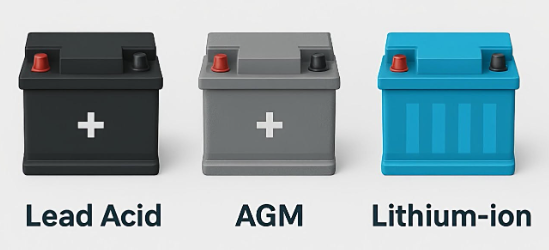
Choosing between AGM, lithium, and lead-acid batteries is confusing because the names are not equal categories. AGM is a sealed lead-acid battery. Flooded lead-acid is the traditional wet-cell option. Lithium covers several chemistries, but for RVs, boats, solar storage, golf carts, and deep-cycle battery banks, most buyers are really comparing lead-acid and AGM against lithium iron phosphate, often called LiFePO4 or LFP.
The short answer: choose lithium LiFePO4 when you need frequent deep cycling, lighter weight, faster charging, and the lowest long-term cost per usable cycle. Choose AGM when you want a sealed, maintenance-free battery for moderate cycling, vibration resistance, backup power, or marine/RV use without moving to lithium. Choose flooded lead-acid when upfront cost matters most and you can handle ventilation, watering, lower usable capacity, and shorter cycle life.
Find the Right Battery Faster
- Quick comparison table
- Main difference between AGM, lithium, and lead-acid
- Usable capacity and depth of discharge
- Cycle life and long-term value
- Charging and charger compatibility
- Weight and space
- Temperature performance
- Safety and maintenance
- Best battery by application
- Common buying mistakes
- FAQ
Quick Comparison: Lithium Wins for Deep Cycling, AGM Wins for Sealed Simplicity, Flooded Lead-Acid Wins on Upfront Price
If you only look at purchase price, flooded lead-acid often looks best. If you compare usable energy, weight, cycle life, and maintenance, lithium LiFePO4 often becomes the better long-term option. AGM sits between them: cleaner and easier than flooded lead-acid, but still limited by lead-acid chemistry.
| Factor | Flooded Lead-Acid | AGM Lead-Acid | Lithium LiFePO4 |
|---|---|---|---|
| Best for | Low-cost starting, backup, and occasional deep-cycle use | Maintenance-free marine, RV, UPS, and moderate cycling | Solar storage, RV house banks, marine house power, golf carts, off-grid systems |
| Usable capacity | Usually limited if you want long life | Often planned around 50% depth of discharge | Often planned around 80% depth of discharge |
| Cycle life | Lowest, especially when deeply discharged | Better than flooded in many use cases, but still lead-acid | Highest in regular deep-cycle use |
| Maintenance | Needs watering and ventilation | Maintenance-free under normal use | Maintenance-free, but needs a battery management system |
| Weight | Heavy | Heavy | Much lighter for the same usable energy |
| Charging | Slowest and sensitive to partial state of charge | Faster than flooded, but voltage-sensitive | Fast charge acceptance when charger and BMS are matched |
| Cold-weather charging | Can be charged in cold within manufacturer limits | Can be charged in cold within manufacturer limits | Should not be charged below freezing unless the battery has low-temperature protection or heating |
| Upfront cost | Lowest | Medium | Highest |
| Long-term cost per cycle | Often higher than it first appears | Medium | Often lowest when cycled daily |
The Main Difference Is Chemistry, Not Just Brand or Price
Flooded lead-acid and AGM both use lead-acid chemistry. The difference is how the electrolyte is held. Flooded batteries contain liquid electrolyte and need ventilation and water maintenance. AGM batteries hold electrolyte in a glass mat, which makes them spill-resistant and easier to install in vehicles and boats. Battery University explains that AGM suspends electrolyte in a specially designed glass mat, giving lead-acid systems faster charging and high load current on demand compared with traditional flooded designs.
Lithium LiFePO4 is different. It uses lithium iron phosphate chemistry, a battery management system, and a higher usable depth of discharge. Battery University notes that LiFePO4 offers good thermal stability, enhanced safety, long cycle life, and high current capability, with a tradeoff of lower energy density than some other lithium-ion chemistries.
AGM Is Better Described as a Sealed Lead-Acid Upgrade
AGM is not a middle ground between lead-acid and lithium in chemistry. It is lead-acid with a sealed valve-regulated design. That makes AGM cleaner, easier to mount, and more resistant to vibration than flooded batteries. It does not remove the main lead-acid limits: lower usable capacity, heavy weight, slower full charging, and shorter deep-cycle life than LiFePO4 in daily cycling.
Lithium Usually Means LiFePO4 for House Batteries
For deep-cycle battery banks, LiFePO4 is usually the lithium type people mean. It is common in RVs, marine house banks, solar storage, telecom backup, and off-grid energy systems because it is more stable than many high-energy lithium chemistries used in phones, laptops, and some EV packs.
Usable Capacity Is Where Lithium Changes the Math
A 100 Ah label does not mean every battery gives the same usable power. Depth of discharge matters. Discharging lead-acid deeply shortens life, so many system designers size AGM and flooded lead-acid banks around about 50% usable capacity. Victron Energy gives a practical example using 50% depth of discharge for AGM and 80% for LiFePO4 in usable-energy comparisons.
| 12 V Battery Example | Rated Energy | Typical Planning DoD | Approximate Usable Energy |
|---|---|---|---|
| 100 Ah flooded lead-acid | About 1.2 kWh | About 50% for longer life | About 0.6 kWh |
| 100 Ah AGM | About 1.2 kWh | About 50% for longer life | About 0.6 kWh |
| 100 Ah LiFePO4 | About 1.28 kWh | About 80% in many designs | About 1.0 kWh |
That is why replacing a 100 Ah AGM with a 100 Ah LiFePO4 battery often feels like a much larger upgrade than the label suggests. In an RV, for example, a 100 Ah AGM bank may run a fridge, lights, water pump, and small inverter for one night. A similar-size LiFePO4 battery may support longer runtime, hold voltage more steadily, and recover faster from solar charging the next day.
Cycle Life Favors Lithium When the Battery Is Used Often
If the battery is used every day, lithium LiFePO4 usually wins. Battery University reports that lead-acid deep-cycle batteries can provide about 200 to 300 discharge/charge cycles depending on depth of discharge, and that deep discharge and high current accelerate aging. The same source lists LiFePO4 cycle life as 2,000 cycles and higher, related to depth of discharge and temperature.
Cycle life is why the "cheapest" battery can become the more expensive battery. A fishing boat that only uses a trolling battery a few weekends a year may not need lithium. A solar storage system that cycles every night is different. If the battery bank discharges and recharges daily, cycle life becomes one of the biggest cost factors.
Lead-Acid Suffers Most When Left Partially Charged
Lead-acid batteries dislike sitting partially charged. Battery University warns that lead-acid batteries should be stored charged and topped up periodically to prevent sulfation. This matters in solar systems, seasonal RVs, boats, and backup systems where the battery may sit for weeks.
Lithium Handles Partial-State Operation Better
LiFePO4 does not need to be held at full charge the same way lead-acid does. For many owners, that is a practical advantage. A solar battery can float through cloudy days at partial charge without the same sulfation concern. The battery still needs correct voltage limits, temperature protection, and a working BMS.
Charging Compatibility Can Decide Whether the Upgrade Works
Lithium is not always a drop-in replacement. A lead-acid charger, alternator, solar controller, or inverter-charger may use charging profiles designed for flooded or AGM batteries. Lithium LiFePO4 needs the correct bulk, absorption, and cut-off behavior. It also needs BMS protection against overcharge, over-discharge, short circuit, and cold charging.
Flooded Lead-Acid Needs Ventilation and Watering
Flooded batteries need a proper charge profile, regular electrolyte checks, and ventilation. Battery University notes that flooded lead-acid watering is a key maintenance step and that charging should happen in a ventilated area because hydrogen gas generated during charging is explosive.
AGM Needs Correct Voltage Control
AGM batteries are sealed and convenient, but they are not careless batteries. Overcharging can dry them out because vented gas and lost water cannot simply be replaced like in a flooded battery. A charger with an AGM setting is a small detail that prevents large problems.
LiFePO4 Needs Charger and BMS Matching
A LiFePO4 battery should be paired with a charger or charge controller that supports lithium settings. In RV and marine systems, alternator charging may need a DC-DC charger to protect the alternator and manage lithium charging correctly. In cold climates, choose a battery with low-temperature charge protection or an internal heater if it may be charged below freezing.
Lithium Saves Weight and Space in Mobile Systems
Weight matters in RVs, boats, golf carts, mobile workstations, and portable power systems. Lead-acid batteries are heavy because lead is heavy. AGM improves packaging and maintenance, but it does not remove the weight problem.
A practical example: a small RV house bank using two 100 Ah AGM batteries may provide roughly the usable energy of one or slightly more than one 100 Ah LiFePO4 battery, depending on the allowed depth of discharge. The lithium setup can reduce weight, free up space, and keep voltage steadier under load. That can matter when running a fridge, lights, fan, water pump, and inverter overnight.
For stationary backup power in a garage or equipment room, weight may not matter much. In a trailer tongue box or small boat, it matters immediately.
Temperature Changes the Best Choice
Battery performance is not fixed. Cold and heat both change the result.
Lead-Acid Handles Cold Discharge Better, but It Still Loses Capacity
Lead-acid has a long history in starting batteries because it can deliver high pulse current, including in cold conditions. Battery University notes that lead-acid works well at cold temperatures and is superior to lithium-ion in subzero operation. This does not mean lead-acid is unaffected by cold. Capacity still drops, and a weak battery may fail when the load is high.
Lithium Discharges Well but Needs Cold-Charge Protection
LiFePO4 can discharge in cold weather within the manufacturer's limits, but charging below freezing can damage cells unless the battery has protection or heating. This is one reason winter RV, marine, and off-grid systems should not be designed only around sunny-weather specs.
Heat Shortens All Battery Life
High temperature is hard on every battery type. Battery University notes that for VRLA batteries, every 8 C rise above 25 C can cut battery life in half. Lithium batteries also age faster in heat, especially when stored full and hot. Keep batteries out of enclosed, unventilated spaces exposed to summer heat.
Safety Depends on Battery Type, Charger Setup, and Disposal
No battery is risk-free. Flooded lead-acid contains acid and can release explosive gas during charging. AGM reduces spill and maintenance concerns but can still vent if abused. Lithium LiFePO4 is one of the safer mainstream lithium chemistries, but it still stores a large amount of energy and must be protected by a BMS and proper fusing.
Lead-Acid Recycling Is Mature, but Lead Is Still Toxic
Lead-acid batteries have one of the strongest recycling systems. EPA notes that the United States recycles lead-acid batteries the most out of all products, recycling 99 percent of them each year. That is good news, but it does not make lead harmless. Lead-acid batteries still need proper handling and recycling.
Lithium Batteries Must Stay Out of Regular Trash
EPA warns that lithium batteries can pose fire hazards to waste management workers and collection facilities when discarded in municipal waste. Used lithium batteries should go through approved recycling or take-back programs, with terminals protected if required by the program.
Correct Fusing Matters More Than the Battery Label
Large battery banks can deliver dangerous fault current. Use correct fuses, breakers, disconnects, cable sizes, busbars, and terminal protection. Many battery failures blamed on chemistry are really design failures: undersized wire, loose lugs, poor crimping, no fuse near the battery, or a charger profile that does not match the battery.
The Cheapest Battery Upfront Is Not Always the Cheapest Battery to Own
Flooded lead-acid has the lowest purchase price. AGM costs more but reduces maintenance and leakage concerns. LiFePO4 costs more upfront, but it often wins when the battery cycles frequently.
For a backup sump pump that runs only during rare outages, a well-maintained AGM may be enough. For a solar cabin that cycles daily, lithium can make more sense because a larger share of the battery is usable and the cycle life is longer. For a truck starting battery, lithium may not be worth the added charging and cold-weather complications unless the vehicle is designed for it.
| Use Pattern | Cost-Sensible Choice | Reason |
|---|---|---|
| Rare backup use | AGM or flooded lead-acid | Low cycle count makes long lithium cycle life less important. |
| Daily solar cycling | LiFePO4 | Higher usable capacity and longer cycle life usually matter more than upfront cost. |
| Engine starting | Flooded lead-acid or AGM | High pulse current, cold performance, and vehicle charging compatibility matter. |
| RV house bank | LiFePO4 if budget allows; AGM for simpler moderate use | Weight, usable energy, and charging speed matter in travel use. |
| Marine house bank | LiFePO4 or AGM | Lithium is best for frequent cycling; AGM is simpler for modest loads and mixed legacy equipment. |
The Best Battery Depends on the Job
For RVs, LiFePO4 Is Best for Regular Off-Grid Camping
If you camp off-grid often, run an inverter, use solar, or want longer runtime with less weight, LiFePO4 is usually the strongest choice. AGM is still practical for weekend campers with modest loads. Flooded lead-acid can work, but ventilation and maintenance are less convenient in modern RV layouts.
For Marine Use, Choose AGM for Simplicity or LiFePO4 for Deep-Cycle House Power
AGM is common on boats because it is sealed, vibration-resistant, and familiar to marine installers. LiFePO4 is better for house loads such as refrigeration, electronics, lighting, and electric cooking, but it needs correct charging from alternators, shore power, and solar. For engine starting, follow the engine and battery manufacturer recommendations rather than assuming lithium is better.
For Solar Storage, LiFePO4 Is Usually the Best Long-Term Choice
Solar batteries cycle frequently and may spend time at partial state of charge. That favors LiFePO4. Flooded lead-acid can still make sense for low-budget systems where maintenance is acceptable. AGM is cleaner but often expensive for the amount of usable energy and cycle life it provides.
For UPS and Emergency Backup, AGM Is Often Still Practical
UPS systems often sit on standby for long periods and discharge only during outages. AGM works well here because it is sealed, stable, and widely supported by charging equipment. Lithium UPS systems can last longer and weigh less, but compatibility and certification matter.
For Golf Carts and Low-Speed Vehicles, LiFePO4 Can Improve Range and Reduce Weight
Golf carts often benefit from lithium because the battery bank is used deeply and frequently. The cart may feel more responsive because voltage stays flatter under load. Before converting, check motor controller limits, charger compatibility, battery tray fit, cable ratings, and state-of-charge display support.
For Car Starting, Lead-Acid or AGM Is Usually the Safer Default
Most vehicles are designed around lead-acid charging behavior. AGM is often used in start-stop vehicles and cars with higher electrical loads. Lithium starting batteries exist, but they need correct battery management and cold-weather consideration. For ordinary car replacement, use the battery type specified by the vehicle manufacturer.
Avoid These Mistakes Before You Buy
- Comparing only amp-hours: A 100 Ah AGM and 100 Ah LiFePO4 battery do not usually provide the same usable energy.
- Ignoring the charger: A lithium battery on the wrong charger may underperform or fail early. An AGM battery on the wrong float voltage can dry out.
- Buying lithium for a cold charging location without protection: Choose low-temperature charge cut-off or heating if charging below freezing is possible.
- Using starter batteries for deep cycling: Starting batteries are built for short bursts, not repeated deep discharge.
- Mixing old and new batteries: Mixed banks age unevenly and can reduce performance.
- Skipping fuses and cable sizing: High-current battery systems need proper protection near the battery.
- Assuming maintenance-free means inspection-free: Terminals, cables, mounting, ventilation, and charger settings still need periodic checks.
Use This Checklist to Pick the Right Battery
- Define the job: engine starting, backup, daily cycling, solar storage, trolling motor, RV house bank, or UPS.
- Calculate usable energy, not just rated amp-hours.
- Check expected cycle frequency: occasional, weekly, or daily.
- Confirm charger, alternator, solar controller, and inverter compatibility.
- Check temperature limits for both charging and discharging.
- Measure the installation space and weight limit.
- Confirm cable size, fuse rating, and disconnect requirements.
- Review warranty terms, especially cycle count, temperature limits, and approved charging equipment.
- Plan end-of-life recycling before installation.
FAQ: AGM, Lithium, and Lead-Acid Batteries
Is AGM better than lead-acid?
AGM is a type of lead-acid battery. It is usually better than flooded lead-acid when you need a sealed, maintenance-free, vibration-resistant battery. Flooded lead-acid is usually cheaper and can be easier to service, but it needs watering and ventilation.
Is lithium better than AGM?
Lithium LiFePO4 is better than AGM for frequent deep cycling, weight savings, fast charging, and long-term usable capacity. AGM may be better for lower upfront cost, simple standby backup, vehicle starting, or systems already built around lead-acid charging.
Can I replace an AGM battery with lithium?
Sometimes, but not blindly. Check charger settings, alternator charging, battery compartment temperature, BMS limits, fuse ratings, and the equipment warranty. RV and marine systems often need a lithium-compatible charger or DC-DC charger.
Which battery lasts longest?
For deep-cycle use, LiFePO4 usually lasts the longest. AGM can last well in moderate cycling or standby service. Flooded lead-acid can last a long time if lightly discharged and maintained, but deep discharge shortens its life.
Which battery is best for solar storage?
LiFePO4 is usually the best choice for solar storage because it handles deeper cycling, partial-state operation, and higher usable capacity better than lead-acid. Flooded lead-acid can still work for low-budget systems where maintenance is acceptable.
Which battery is safest?
Each type has different risks. Flooded lead-acid has acid and gas risks. AGM reduces spill risk but can still vent if overcharged. LiFePO4 is one of the safer lithium chemistries, but it still needs a BMS, proper fusing, and correct charging.
Why does my lithium battery seem stronger than the same Ah AGM battery?
Lithium holds voltage more steadily and allows a deeper usable discharge. A 100 Ah AGM is often planned around about 50 Ah usable for long life, while a 100 Ah LiFePO4 battery is often planned around about 80 Ah usable.
Are lead-acid batteries bad for the environment?
Lead is toxic and lead-acid batteries must be handled properly, but the recycling system is very mature. EPA notes that lead-acid batteries are recycled at very high rates in the United States. Improper disposal is still dangerous and should be avoided.
The Right Battery Is the One That Matches the Workload
For a battery that sits on standby and rarely cycles, AGM or flooded lead-acid can be a sensible buy. For a battery that works every day in solar, RV, marine house power, off-grid, golf cart, or mobile energy storage use, LiFePO4 usually delivers more usable energy and longer service life.
The best comparison is not AGM vs lithium vs lead-acid in theory. It is your load, your charger, your temperature range, your available space, and your cycle pattern. Start there, and the right battery type becomes much easier to choose.
- Next:DIY Home Energy Storage Batteries: Benefits, Costs, Safety, and Setup Tips
- Previous:UPS with Lithium Ion Battery: Benefits, Sizing, Safety, and Buying Guide
Contact Details
Lithium LiFePO4 Batteries and Lithium LiFePO4 Cells Supplier - LiFePO4 Battery Shop
Contact Person: Miss. Elena Wang
WhatsApp : +8615263269227
Skype : +8615263269227
WeChat :15263269227
Email : info@lifepo4batteryshop.com
All Products
- Forklift Battery Charger (0)
- TC Elcon Charger (5)
- Headway Lithium Battery (6)
- Blade Battery (10)
- Semi Solid State Battery (6)
- A123 Battery (6)
- Sinopoly Battery (7)
- GBS Battery (20)
- CALB Battery (26)
- Cylindrical Cell (14)
- Energy Storage System (0)
- Battery Management System (15)
- Sodium ion Battery Cell (4)
- Lithium Titanate Battery (23)
- Ternary Lithium Battery Cell (12)
- REPT Battery (10)
- BYD Battery (5)
- CATL Battery (15)
- Thunder Sky Winston Battery (26)
- EVE Battery (39)
- LiFePO4 Battery Cell (41)
Certification
Customer Reviews
- I have fond memories of our meeting in Shanghai with LiFePO4 Battery Shop Elena. Your company left a strong impression on me with its impressive growth and professionalism. We both value straightforwardness and honesty, which I believe are the most important qualities in any partnership. I am confident that we can build a successful collaboration based on these shared values. —— Robert from USA
- I've been working with LiFePO4 Battery Shop for years, and their reliability is unmatched. While other suppliers frequently change sales teams, LiFePO4 Battery Shop has consistently provided exceptional service with a stable team. Their commitment to quality and customer support truly sets them apart. —— Henry from Australia