
Blog
AGM Battery Pros and Cons: A Complete Guide for 2026
2026-05-17 | Calvin
What Is an AGM Battery?
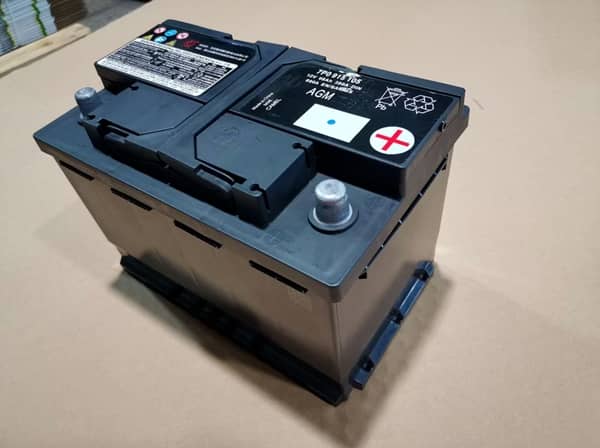
An AGM battery is a sealed, valve-regulated lead-acid (VRLA) battery where the sulfuric acid electrolyte is absorbed into a thin fiberglass mat sandwiched between the lead plates. No free liquid. No spills. No watering.
The design dates back to 1985, when Concorde Battery developed AGM batteries for U.S. military aircraft — the F-117A Stealth Bomber and F/A-18 fighter jet still use AGM-derived designs. The commercial market picked them up through the late '80s and '90s, and today AGM is the default for premium car batteries, RVs, boats, motorcycles, UPS systems, and entry-level solar.
Quick technical primer:
- Nominal cell voltage: 2.0V (six cells = 12V battery)
- Energy density: ~50–70 Wh/kg
- Typical lifespan: 3–7 years
- Cycle life: 300–500 cycles at 50% DoD (premium brands like Lifeline claim ~1,000)
- Internal resistance: ~2% (vs. 10–15% for flooded lead-acid)
- Self-discharge: 2–3% per month at 25°C / 77°F
That low internal resistance is the headline number. It's why AGM batteries charge faster, deliver higher cranking amps, and recover from deep discharge better than the flooded battery they likely replaced in your car.
AGM Battery Pros: What They Do Well
1. Spill-Proof and Maintenance-Free
The fiberglass mat immobilizes the electrolyte. Crack the case open and acid won't pour out. That's why AGM batteries are exempt from many hazmat shipping restrictions and why you can mount them sideways, on end, or anywhere except upside down (the pressure-relief valves need to point up).
For RV owners, boat owners, and anyone tired of topping up water in flooded batteries every few months — AGM eliminates that chore entirely.
2. Vibration and Shock Resistance
The "sandwich" construction — plates compressed against the mats — means internal components don't shift, crack, or shed material under vibration. This is why AGM is standard equipment on:
- Motorcycles and ATVs
- Race cars and off-road vehicles
- Commercial marine vessels
- Construction equipment
- Military aircraft
3. Fast Charging and High Current Output
Low internal resistance (~2%) means AGM batteries can accept higher charge currents and deliver more cold-cranking amps than flooded batteries of the same size. According to industry data, AGM batteries can charge up to 5x faster than conventional flooded lead-acid given a compatible charger.
4. Low Self-Discharge in Storage
A flooded battery loses 5–15% of its charge per month sitting on a shelf. AGM loses 2–3%. For seasonal equipment — boats, motorcycles, snow blowers, RVs — that means starting up after a winter without a dead battery, assuming you didn't leave parasitic loads connected.
5. Safe for Enclosed Spaces
AGM batteries recombine oxygen and hydrogen gases internally during charging. Minimal off-gassing means you can install them inside cabins, electronics enclosures, or under-seat compartments without ventilation concerns. Caveat: They're not zero-gas. Lifeline and other manufacturers explicitly warn against fully sealed containers because charging faults can still vent hydrogen.
6. Wide Operating Temperature Range
AGM performs better than flooded lead-acid in the cold and outlasts lithium in extreme low temperatures. LiFePO4 batteries refuse to charge below 0°C / 32°F without internal heaters. AGM will keep cranking at -20°C, which is why cold-climate RVers and overlanders still pick AGM over lithium for chassis batteries.
7. Sulfation Resistance
In a flooded battery, lead sulfate crystals build up on the plates during partial charging cycles — and eventually kill the battery. AGM's tightly packed plates and saturated mat slow this process significantly. You can leave an AGM sitting at a partial state of charge longer than a flooded battery without permanent damage (though you still shouldn't make a habit of it).
AGM Battery Cons: Where They Fall Short
1. Higher Upfront Cost Than Flooded
AGM batteries cost roughly 40–100% more than flooded lead-acid of the same capacity. A typical 12V 100Ah AGM runs $200–$350; premium brands like Lifeline can hit $450+. Flooded equivalents start around $100–$150.
2. Sensitive to Overcharging
This is the #1 way people kill AGM batteries. The sealed design leaves no room for gas expansion. If your charger overshoots voltage even modestly, you'll cause:
- Excessive gas venting (lost electrolyte you can't replace)
- Plate corrosion
- Reduced capacity
- Premature failure
3. Limited Depth of Discharge
For maximum cycle life, AGM batteries should not be discharged below 50% state of charge routinely. Push them to 20% and you'll get a fraction of the rated cycle count.
4. Heavy
A 100Ah 12V AGM weighs roughly 60–70 lbs (27–32 kg). A LiFePO4 equivalent weighs 25–30 lbs (11–14 kg) — less than half.
5. Shorter Cycle Life Than Lithium
Typical AGM cycle life at 50% DoD: 300–500 cycles. Premium brands like Lifeline: ~1,000 cycles. LiFePO4: 3,000–7,000 cycles at 80% DoD.
6. Limited Charge Acceptance Rate
While AGM charges faster than flooded, it can't match LiFePO4. AGM accepts charge at roughly 0.3C–0.5C. LiFePO4 handles 1C or higher.
7. Needs Full Recharging Between Uses
Letting an AGM sit at partial state of charge accelerates sulfation. For seasonal storage you need a maintenance charger. For daily use confirm your charging system returns the battery to 100%.
8. Older Chargers and Testers May Not Work
Pre-2010 "smart" chargers may overcharge your battery. Budget another $50–$150 for an AGM-compatible charger if you don't already have one.
AGM vs. Flooded vs. LiFePO4: Side-by-Side
| Factor | Flooded Lead-Acid | AGM | LiFePO4 |
|---|---|---|---|
| Upfront cost (12V 100Ah) | $100–$150 | $200–$350 | $400–$900 |
| Cycle life @ recommended DoD | 200–400 @ 50% | 300–1,000 @ 50% | 3,000–7,000 @ 80% |
| Usable capacity | ~50% | ~50% | ~80–100% |
| Weight (12V 100Ah) | ~60 lbs | ~60–70 lbs | ~25–30 lbs |
| Energy density | ~30–40 Wh/kg | ~50–70 Wh/kg | ~90–160 Wh/kg |
| Maintenance | Watering needed | None | None |
| Self-discharge/month | 5–15% | 2–3% | 1–3% |
| Charging speed | Slow | Fast | Very fast |
| Cold tolerance (discharge) | Good | Excellent | Good |
| Cold tolerance (charging) | Good | Good | Poor (<0°C) |
| Lifespan (years) | 3–5 | 3–7 | 10–15 |
| Total cost over 10 years | Highest (replacements) | Mid | Lowest |
When AGM Is the Right Choice
Pick AGM if:
- Modern car with start-stop technology
- Motorcycle, ATV, or off-road vehicle
- Marine application with moderate cycling
- UPS or backup power source with infrequent discharge
- Extreme cold and reliable cranking power needed
- Cannot justify lithium price premium
Skip AGM and go LiFePO4 if:
- Daily deep cycling (full-time RV, off-grid cabin, electric trolling motor)
- Weight matters
- Want a 10+ year battery and can afford upfront cost
- Need fast charging from solar or alternator
Skip AGM and go flooded if:
- Absolute cheapest option
- Comfortable with regular maintenance
- Don't need sealed battery and have proper ventilation
How to Make Your AGM Battery Last Longer
- Use the right charger. AGM-specific profile, temperature compensation, correct absorption/float voltages (14.4V absorb / 13.5V float).
- Don't deep cycle below 50%. Add capacity instead of squeezing more out of existing batteries.
- Recharge fully and promptly. Don't leave partially discharged for weeks. Use maintenance charger if storing.
- Manage temperature. AGM tolerates heat better than lithium, but sustained operation above 30°C/86°F shortens life.
For long-term storage: fully charge before storing, disconnect parasitic loads, store in a cool dry place, and reconnect to a smart maintainer or top-off every 3 months.
AGM Battery FAQs
Q: How long do AGM batteries last?
A: Typically 3–5 years starting, 5–7+ in deep-cycle use. Premium brands like Lifeline: 8–10 years.
Q: Can I charge an AGM battery with a regular charger?
A: Sometimes, but risky. Older smart chargers without AGM profile may overcharge. Use AGM-specific charger.
Q: What is the main disadvantage of an AGM battery?
A: Sensitivity to overcharging. Higher upfront cost vs. flooded is next.
Q: Can I replace a flooded battery with an AGM?
A: Yes, drop-in compatible for same voltage and group size. Confirm alternator or charger supports AGM.
Q: Are AGM batteries worth the extra cost?
A: Yes for modern vehicles, motorcycles, and marine. For light-use backup, flooded is fine. For deep-cycle daily use: skip AGM, go LiFePO4.
Q: Can AGM batteries be installed sideways or upside down?
A: Sideways: yes. Upside down: no — pressure-relief valves must vent upward.
Q: Why are AGM batteries required for start-stop cars?
A: Start-stop systems demand high charge acceptance and durability. AGM handles thousands of micro-cycles.
Conclusion
AGM batteries fill a niche: better than flooded on convenience, safety, and performance — without lithium's upfront cost or cold-charging limits. Right choice for modern vehicles, motorcycles, moderate marine use, and sealed/vibration-resistant needs.
For daily deep cycling, weight-sensitive applications, or long-term cost optimization: LiFePO4 is better. Tight budgets with proper maintenance: flooded works.
Match chemistry to duty cycle — that's the key rule.
- Next:How to Configure 3.2V LiFePO4 Cells to Build 12V, 24V & 48V Battery Packs: The Complete DIY Guide
- Previous:What Is a LiFePO4 Battery? Complete Guide (2026) — Chemistry, Pros, Cons & Uses
Contact Details
Lithium LiFePO4 Batteries and Lithium LiFePO4 Cells Supplier - LiFePO4 Battery Shop
Contact Person: Miss. Elena Wang
WhatsApp : +8615263269227
Skype : +8615263269227
WeChat :15263269227
Email : info@lifepo4batteryshop.com
All Products
- TC Elcon Charger (0)
- Headway Lithium Battery (6)
- Blade Battery (10)
- Semi Solid State Battery (6)
- A123 Battery (6)
- Sinopoly Battery (7)
- GBS Battery (16)
- CALB Battery (25)
- Cylindrical Cell (9)
- Energy Storage System (0)
- Battery Management System (15)
- Sodium ion Battery Cell (4)
- Lithium Titanate Battery (22)
- Ternary Lithium Battery Cell (12)
- REPT Battery (10)
- BYD Battery (5)
- CATL Battery (15)
- Thunder Sky Winston Battery (26)
- EVE Battery (35)
- LiFePO4 Battery Cell (18)
Certification
Customer Reviews
- I have fond memories of our meeting in Shanghai with LiFePO4 Battery Shop Elena. Your company left a strong impression on me with its impressive growth and professionalism. We both value straightforwardness and honesty, which I believe are the most important qualities in any partnership. I am confident that we can build a successful collaboration based on these shared values. —— Robert from USA
- I've been working with LiFePO4 Battery Shop for years, and their reliability is unmatched. While other suppliers frequently change sales teams, LiFePO4 Battery Shop has consistently provided exceptional service with a stable team. Their commitment to quality and customer support truly sets them apart. —— Henry from Australia