
News
NFPP vs NFS: Who Will Dominate the Polyanionic Sodium Battery Track?
2026-10-23 | Calvin
The sodium battery track is undergoing a profound transformation in technology roadmaps.
In the early stage of industrial development, layered oxide sodium battery technology, with its theoretical advantage of high energy density and its goal of "replacing lithium batteries," became the mainstream direction eagerly pursued by the sodium battery industry chain.
However, since 2025, the market wind has clearly shifted. The polyanionic sodium battery technology roadmap, relying on outstanding advantages such as structural stability and long cycle life, has helped sodium batteries establish a market position independent of lithium batteries in the long-life requirements of energy storage, thereby achieving a strong overtake over layered oxide sodium battery technology, accounting for more than 70% of newly added sodium battery installations and becoming the absolute main force in the current market.
At the same time, within the polyanionic system, there are multiple sub-technology roadmaps clustered together, including NFPP (composite sodium iron phosphate, sodium iron phosphate pyrophosphate), NFS (sodium iron sulfate), and NVP (sodium vanadium phosphate).
It is worth noting that NFPP and NFS, these two technology roadmaps, are commercializing faster, leading the development of the polyanionic track, and have already embarked on different development trajectories.
The two are not successive versions of technological iteration, but two independent solution sets, with significant differences in intrinsic material characteristics, product positioning, and suitable application scenarios.
On the market side, material and cell companies such as Jiana Energy, Yingna New Energy, Chaowei, and Zhongna Energy, as well as OEMs such as Yadea, Tailg, Xinri, and Hithium Energy Storage, have carried out related implementation actions in fields such as two-wheelers and energy storage, which also intuitively confirm an industrial reality: leading companies no longer lay out their plans with the mindset of "betting on technology," but choose technology roadmaps based on scenario requirements, allowing two sodium battery cathode material roadmaps of the same origin to each take root in more suitable incremental markets.
Same Origin, Different Paths: Each Technology Has Its Strengths and Weaknesses, Scenarios Define Division of Labor
NFPP and NFS, both belonging to the polyanionic system, have stable framework structures and outstanding safety, which can effectively avoid the structural instability shortcomings of Prussian blue analogs and layered oxide materials. However, the two differ significantly in process maturity, voltage, moisture sensitivity, cycling, and cost, which has also led to a divergence in their commercialization paths.
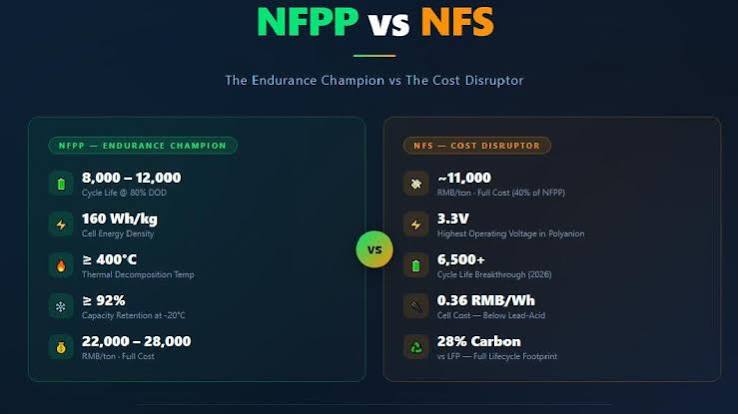
Data shows that NFPP's core competitiveness lies in its strong structural fault tolerance, slow cycle degradation, relatively mature production process, and lower threshold for industrialization. But its shortcomings are equally obvious: its working voltage and energy density are not advantageous, and it is still difficult to adapt to the high-power demand of passenger vehicles.
Therefore, NFPP technology is currently mainly oriented toward large-scale energy storage scenarios with stringent requirements for safety and service life. Combined with its higher process maturity, it has also become the mainstream technology roadmap for sodium batteries used in two-wheelers.
On the material side, Jiana Energy and Yingna New Energy continue to advance the large-scale implementation of NFPP. Jiana took the lead in building a 10,000-ton-level NFPP production line, steadily supplying cell companies in energy storage and other scenarios; Yingna New Energy's NFPP material production line with an annual capacity of 5,000 tons has been running at full capacity, and a supporting 10,000-ton-level base is ready to go, continuously releasing capacity to support energy storage demand.
The maturity of materials has also laid the foundation for product iteration on the cell side.
Recently, Hithium Energy Storage launched a 785Ah ultra-large-capacity sodium battery cell product based on NFPP technology. Data shows that relying on the material's three-dimensional stable framework, this product has a 20,000-cycle native long cycle life, with a designed service life of 30 years, matching 2-8 hour power energy storage dispatch scenarios. This is also expected to further amplify the scenario value of NFPP technology's long cycling.
Chaowei's NFPP sodium batteries have currently achieved mass production and large-scale sales, and related products are supplied to OEMs such as Yadea, Tailg, and Xinri, which may continue to drive the volume application of upstream materials.
Unlike NFPP's long-cycle characteristics, the biggest advantages of NFS technology are high voltage, high rate, and large cost-reduction potential, naturally adapting to market demand in scenarios such as light power and power-type energy storage.
At the same time, NFS materials do not contain phosphorus. Against the backdrop of rising phosphorus source prices this year, they have more room for material cost reduction.
Zhongna Energy is one of the representative companies on the NFS roadmap. Its subsidiary Meishan Lina has built a 10,000-ton-level NFS material production line and has also planned 30,000 tons of cathode materials and 5GWh of sodium battery PACK capacity, thereby connecting the entire chain from material synthesis to system integration.
On the application side, in August this year, Zhongna Energy reached cooperation with Anqing Chaoren, a subsidiary of Chaowei Group. The two parties will rely on NFS technology to carry out in-depth cooperation around the two-wheeler, three-wheeler, and low-speed vehicle markets to accelerate the large-scale penetration of sodium batteries in the light power field.
This cooperation also reflects that Chaowei is not betting solely on the NFPP roadmap, but simultaneously retaining an NFS technology layout, which may cover the light power market with different performance requirements.
In addition, Zhongna Energy has also reached relevant cooperation with Sichuan Puli Technology. The two parties will collaborate around power-type scenarios such as backup power for communication base stations to broaden the application boundaries of NFS.
Behind corporate layouts is the selection logic being established by the industry: there is no "universal sodium battery" that works for all scenarios, only better solutions that match end demand. NFPP, with its long life and process maturity, takes root in tracks such as long-duration energy storage and light power; NFS, with its high voltage and high power characteristics, seizes the power-type market and is expected to enhance the application potential of sodium batteries in high-load and high-speed applications in the e-bike and electric motorcycle fields, thereby giving full play to their respective strengths.
Both Roadmaps Face Bottlenecks in Industrialization
While scenario advantages are being established, the industrialization of the two roadmaps still faces respective technical and manufacturing hurdles that need to be overcome.
For the NFPP roadmap, the biggest limitations are concentrated in energy density and process difficulty. The room for improving material compaction density is limited, which may lead to a natural upper limit on cell energy density, making it difficult to enter the passenger vehicle power scenario.
If doping modification is used to optimize material capacity and break through scenario boundaries, long-term process efforts are still needed.
The core challenge of the NFS roadmap is material stability and mass production control difficulty. NFS materials are highly hygroscopic, and trace amounts of moisture can easily trigger side reactions, affecting cell cycle performance and batch consistency. Therefore, strict requirements are imposed on dew point and humidity standards in production workshops. At the same time, the high voltage platform places higher demands on electrolyte and interfacial film formation quality, making mass production yield control more difficult.
At the same time, constrained by intrinsic chemical properties, the long-cycle capability of conventional NFS cells is insufficient and still awaits collaborative improvement by industry chain companies.
Data shows that Zhongna Energy has, through process optimization and architecture upgrades, compensated to a certain extent for NFS's inherent shortcomings and successfully achieved large-scale delivery.
It is expected that in the short to medium term, the polyanionic track will not see a situation where "one roadmap eliminates the other," but will move toward a pattern of scenario-based division of labor and coexistence.
The division of labor between NFPP and NFS means that this track has entered a new stage of on-demand adaptation. The core of competition on the track is no longer a comparison of single parameters, but a focus on scenario implementation and value realization.
In the long run, improving the full-chain engineering capability of technology roadmaps is particularly important, including precursor consistency, production line energy consumption, batch stability, and the ability to jointly develop with downstream cell manufacturers. These two roadmaps may, with their respective advantages, jointly support the industrialization of the polyanionic track.
- Next: Dr. Robin Zeng: From Scale Explosion to Long-Term Reliability, Energy Storage Enters the Era of New Infrastructure
- Previous: Unveiling the Roadster's Power Battery: Backed by Tesla's Most Advanced Technology, Replenishing 70% Charge in 10 Minutes
Contact Details
Lithium LiFePO4 Batteries and Lithium LiFePO4 Cells Supplier - LiFePO4 Battery Shop
Contact Person: Miss. Elena Wang
WhatsApp : +8615263269227
Skype : +8615263269227
WeChat : 15263269227
Email : info@lifepo4batteryshop.com
All Products
Certification
Customer Reviews
- I have fond memories of our meeting in Shanghai with LiFePO4 Battery Shop Elena. Your company left a strong impression on me with its impressive growth and professionalism. We both value straightforwardness and honesty, which I believe are the most important qualities in any partnership. I am confident that we can build a successful collaboration based on these shared values. —— Robert from USA
- I've been working with LiFePO4 Battery Shop for years, and their reliability is unmatched. While other suppliers frequently change sales teams, LiFePO4 Battery Shop has consistently provided exceptional service with a stable team. Their commitment to quality and customer support truly sets them apart. —— Henry from Australia