News
Gotion Launches "GNASCENT" Sodium-Ion Battery: High-Energy Version Reaches 261Wh/kg, Storage Version Exceeds 20,000 Cycles
2026-05-22 | Calvin
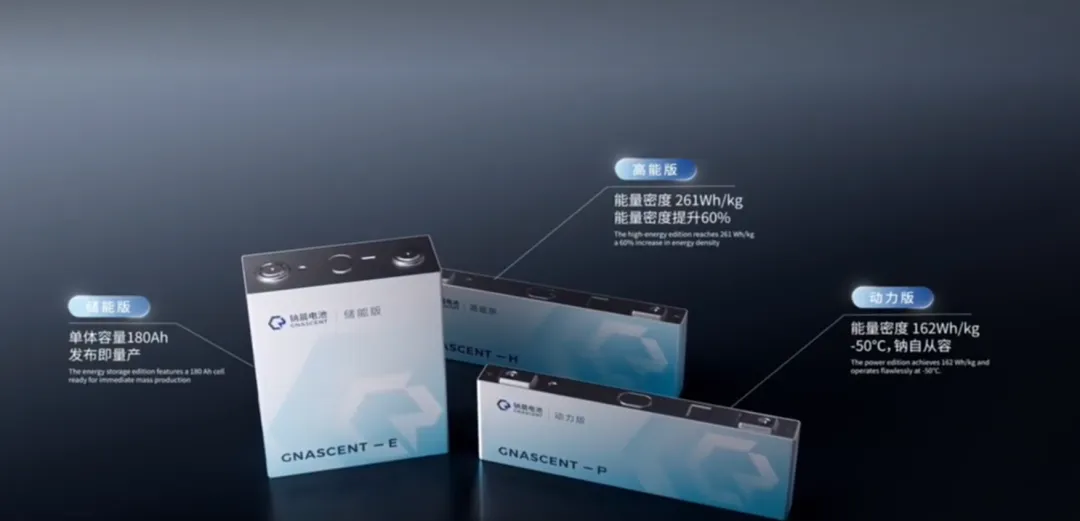
On May 17, 2026, at the 15th Global Technology Conference, Gotion officially unveiled its sodium-ion battery brand, GNASCENT, marking another major lithium battery company’s strong entry into the sodium-ion battery market.
The newly launched high-energy version achieves an energy density of 261Wh/kg, approximately 60% higher than traditional sodium batteries, significantly surpassing the industry average.
Gotion has adopted a multi-scenario strategy for its sodium-ion products: the power version supports ultra-low-temperature discharge down to -50°C with an energy density of 162Wh/kg, suitable for commercial vehicle applications; the storage version features a single-cell capacity of 180Ah and a cycle life exceeding 20,000 cycles, maintaining over 88% capacity even at -40°C extreme conditions; while the high-energy version targets lightweight electric vehicles, drones, and other weight-sensitive applications, expanding the application boundaries of sodium-ion batteries.
From a technical perspective, the GNASCENT battery employs a anode-free structure, improving energy density by eliminating the traditional anode current collector. The multi-stage pre-sodiation technology reduces reaction energy barriers, effectively enhancing cell cycling performance. Additionally, the self-isolating interface technology provides critical protection against short circuits and thermal runaway risks.
Regarding low-temperature performance and efficiency, the GNASCENT battery accelerates ion diffusion through high-diffusion materials and confines the electrolyte entirely within the electrodes using a high-retention design, shortening ion diffusion paths to achieve rapid and efficient ion transport.
In safety tests, GNASCENT batteries passed extreme trials, including 8mm steel needle penetration and 400°C high-temperature heating, demonstrating outstanding performance without fire or explosion.
Currently, the GNASCENT battery storage category has completed technical finalization and product release, with mass production preparations already underway. Leveraging Gotion's existing GWh-level highly automated production lines and mature manufacturing systems, the product is expected to enter large-scale mass production in Q4 2026. Subsequently, Gotion plans to expand its sodium-ion product line to include new energy vehicle power and specialized equipment applications.
Gotion’s sodium-ion battery development has been a gradual process. The company began early-stage research around 2016, systematically tackling core areas such as electrode materials and electrolyte compatibility.
In August 2023, Gotion signed a collaboration agreement with Fudan University, establishing an Advanced Battery Technology Joint Research Center. The partnership focuses on joint R&D and exchange on sodium-ion batteries, thermal insulation materials, lithium iron phosphate manganese materials, and other advanced materials and battery technologies.
Collaboration with top universities provides Gotion with sustained R&D support, forming a solid technical foundation for its long-term sodium-ion industry strategy.
Notably, Gotion’s deep cooperation with Volkswagen Group opens the possibility for its sodium-ion technology to be applied in vehicles. In May 2020, Volkswagen officially invested approximately €1.1 billion to acquire a 26.47% stake in Gotion, becoming its largest shareholder. In July 2021, both parties signed a strategic cooperation framework agreement, designating Gotion as a key developer for Volkswagen standard cells. Before the global first standard cell mass production, their joint R&D team completed thousands of test validations, with Gotion becoming the first to receive Volkswagen cell testing laboratory qualification, and in 2024, earning Volkswagen's “Best Supplier” award.
According to Volkswagen’s previous plans, this square standard cell, defined by Volkswagen’s size and specifications, will be used in affordable EV models by 2026 and will cover 80% of Volkswagen EVs by 2030. Importantly, this standard cell platform supports NMC, LFP, sodium-ion, and future solid-state chemistries — meaning Gotion’s newly launched GNASCENT sodium-ion battery could potentially be adapted to Volkswagen’s standard cell platform. Once technical verification and production line adaptation are completed, sodium-ion batteries could expand from storage and low-speed vehicle applications to broader automotive scenarios, becoming a key technology option for Volkswagen’s affordable EVs.
Currently, sodium-ion batteries, with their cost advantages, high safety, and excellent low-temperature performance, have already shown clear value in storage, two-wheelers, and low-speed electric vehicles. A new industry pattern of “lithium-sodium complementarity and scenario differentiation” is accelerating. With industry leaders like CATL, EVE Energy, Sunwoda, Gotion, and Haichen Storage investing heavily in sodium-ion batteries, the era of sodium-ion technology is rapidly approaching.
- Next: Gotion High-Tech Unveils Seven New Batteries: Solid-State Battery Targets 1 RMB/Wh, Sodium Battery Mass Production in Q4
- Previous: FinDreams Battery Shines at CIBF 2026: Second-Generation Blade Battery Steals the Show
Contact Details
Lithium LiFePO4 Batteries and Lithium LiFePO4 Cells Supplier - LiFePO4 Battery Shop
Contact Person: Miss. Elena Wang
WhatsApp : +8615263269227
Skype : +8615263269227
WeChat : 15263269227
Email : info@lifepo4batteryshop.com
All Products
Certification
Customer Reviews
- I have fond memories of our meeting in Shanghai with LiFePO4 Battery Shop Elena. Your company left a strong impression on me with its impressive growth and professionalism. We both value straightforwardness and honesty, which I believe are the most important qualities in any partnership. I am confident that we can build a successful collaboration based on these shared values. —— Robert from USA
- I've been working with LiFePO4 Battery Shop for years, and their reliability is unmatched. While other suppliers frequently change sales teams, LiFePO4 Battery Shop has consistently provided exceptional service with a stable team. Their commitment to quality and customer support truly sets them apart. —— Henry from Australia