
News
CATL officially unveiled the TENER Sodium Energy Storage System
2026-07-03 | Calvin
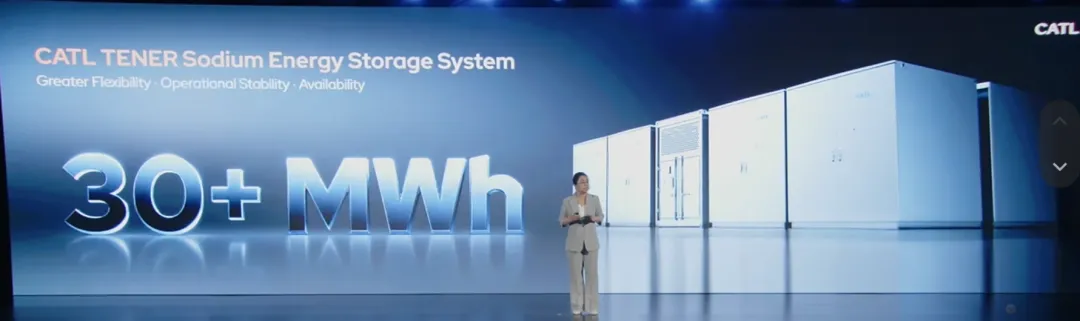
Recently, CATL unveiled the world’s first station-level sodium-ion energy storage system, Tianheng Sodium-ion Storage, at a launch event in Munich, Germany.
Custom-built exclusively for sodium-ion battery platforms, this product supports diverse energy storage durations including 1-hour, 2-hour, 4-hour, 6-hour and 8-hour configurations. Each system cabinet weighs less than 42 tons, and only 34 units are required to assemble a 1GWh energy storage station.
In terms of technical specifications, a single unit delivers a maximum energy capacity exceeding 30 MWh, with a cycle life of 15,000 times at 25°C. It retains over 92% of its rated capacity at -20°C, equipped with a Bi-DC bidirectional voltage control system that completes fault self-recovery within 350 milliseconds, while auxiliary power consumption is reduced to merely 1%.
Behind these figures lies a far more pivotal signal than a single new product release: sodium-ion energy storage is transitioning from cell validation and small-scale demonstration projects to systematic, large-scale commercial deployment for utility-scale energy storage power stations.
Elevated Commercialization Barriers for Sodium-ion Storage: From Battery Cells to Full Power Stations
A station-level sodium-ion energy storage system is far more than simply loading sodium-ion batteries into storage cabinets. Tailored for full-scale energy storage power stations, it must simultaneously address capacity integration, safety protection, cycle life management, low-temperature adaptability, grid connection coordination and long-term operation & maintenance challenges.
For power station operators, energy storage systems represent long-term capital assets rather than one-time equipment purchases. Metrics including cycle life, usable capacity, system efficiency, fault response speed and auxiliary power consumption ultimately determine project profit margins.
This is where Tianheng Sodium-ion Storage stands out. Its 30+ MWh single-unit capacity delivers robust integration capabilities for large-scale energy storage scenarios; the 15,000-cycle lifespan meets the high-frequency charge-discharge demands of power stations over decades; and its 92% capacity retention at -20°C expands its applicability to frigid regions across Europe and Northern China.
Low-temperature performance and abundant raw material supply have long been core selling points of sodium-ion batteries. By translating these material advantages into concrete station-level product parameters, CATL converts material strengths into tangible system value.
The Bi-DC bidirectional voltage control system stands out as another highlight. Unlike lithium-ion batteries, sodium-ion cells feature a wider voltage platform fluctuation range. Directly repurposing conventional lithium energy storage systems would compromise PCS matching and overall operational efficiency.
CATL’s proprietary voltage control platform leverages intelligent voltage boosting technology to sustain the PCS at an optimal 690V output across the full voltage spectrum, ensuring the system operates under peak working conditions at all times — a design perfectly aligned with the operational requirements of large energy storage stations.
Extremely low auxiliary power consumption is another core advantage of this station-grade sodium-ion storage system. Its unique top-air-out unit design cuts system heat generation by nearly 30% compared with traditional solutions. Combined with high-efficiency liquid cooling units, auxiliary power draw drops from the lithium industry average of 2% down to 1%.
CATL also developed a dedicated BMS for sodium-ion energy storage systems to enable ultra-precise SOC estimation and intelligent control strategies. This architecture underpins the millisecond-level self-recovery function: the system can locate faults, isolate defective segments and restore power supply to unaffected areas within 350 milliseconds, drastically streamlining maintenance workflows.
Expanded Industrial Scale Window: Sodium-ion Batteries as a Core Market Entry Point
From an industrial perspective, the launch of Tianheng Sodium-ion Storage establishes a clear scaled-up development roadmap for the entire sodium-ion battery supply chain.
Over the past few years, the sodium-ion industry has primarily focused on validation of cathode materials, hard carbon anodes, electrolytes and cell manufacturing processes. While technical enthusiasm remains high, the sector lacked stable, clearly defined large-scale commercial application scenarios. Utility-scale energy storage represents the most promising market to deliver a fully closed commercial loop for sodium-ion technology.
Compared with power batteries for electric vehicles, stationary energy storage imposes relatively loose requirements on energy density yet prioritizes safety, cycle life, cost competitiveness and raw material accessibility. Sodium resources are widely distributed globally with minimal supply constraints, theoretically positioning sodium-ion batteries to satisfy demand for long-duration, large-scale energy storage.
With leading manufacturers like CATL rolling out station-grade sodium-ion storage systems, upstream segments including hard carbon anodes, sodium salts, cathode materials, electrolytes, battery cells, BMS, thermal management, voltage control systems and PCS matching technologies, alongside downstream applications such as new energy paired storage, independent energy storage and grid-side storage, will all receive clear demand-driven growth momentum.
CATL’s accelerated investment in sodium-ion energy storage coincides with major shifts in the global energy storage market. Surging new energy installed capacity intensifies grid volatility, power demand from AI data centers expands rapidly, and European nations ramp up energy security priorities — together transforming large-scale energy storage from an optional auxiliary facility into critical infrastructure for the new power system.
A single lithium-ion technology pathway cannot fully cover all market scenarios. Lithium iron phosphate batteries will remain the mainstream energy storage solution, yet lithium price volatility, concentrated supply chains, overseas localisation mandates and low-temperature operational demands are pushing the industry to develop a second viable technical route.
Lithium-Sodium Synergy: Reshaping the Next-Generation Energy Storage Landscape
Sodium-ion batteries are not poised to replace lithium-ion batteries in the near term; instead, they will serve as a complementary solution for specific energy storage use cases. Lithium batteries dominate applications requiring mature technology, high efficiency and high energy density, while sodium-ion batteries unlock new market space via superior resource security, low-temperature performance, safety redundancy and cost reduction potential.
CATL’s proposition that lithium and sodium batteries will jointly form the dual cornerstones of next-generation energy storage reflects this industry megatrend.
Critically, CATL possesses comprehensive industrial capabilities to commercialize sodium-ion batteries at scale. Sodium-ion technology requires long-term R&D and manufacturing expertise spanning materials, cells and system integration, while station-level energy storage additionally demands global customer networks, large project delivery capacity, complete operation & maintenance systems and international certification credentials.
CATL disclosed at the launch event that its sodium-ion cathode and anode material production lines have achieved 10,000-ton annual output capacity. The company invested 650 million euros to expand its Fuding sodium-ion manufacturing base, adding 40 GWh of production capacity, while its Jining, Shandong facility plans an additional 160 GWh of sodium-ion capacity. All of CATL’s sodium-ion production lines are now fully commissioned and operating stably.
In terms of product delivery, CATL’s first batch of sodium-ion energy storage solutions will ship to the Chinese market starting September 2026, targeting total shipments of 1 GWh by the end of 2026. Global market deliveries are scheduled to commence in June 2027.
Back in April this year, CATL signed a three-year strategic cooperation agreement with Haibo Energy Storage for 60 GWh of sodium-ion batteries — the world’s largest sodium-ion energy storage order to date, laying a solid demand foundation for mass supply of the Tianheng storage system.
With sustained investment in sodium-ion technology, supply chains and energy storage system platforms, the launch of Tianheng Sodium-ion Storage marks CATL’s shift from technical demonstrations to fully integrating sodium-ion products into its mass-produced energy storage portfolio.
From a long-term outlook, Tianheng Sodium-ion Storage symbolises a pivotal shift in energy storage technology: moving beyond lithium-ion-only dominance toward multi-system collaborative development. Future large-scale energy storage power stations will no longer evaluate battery performance solely based on cell energy density, but holistically assess total lifecycle costs, safety reliability, environmental adaptability, raw material security and grid-friendliness.
Enterprises capable of integrating electrochemical cell design, system integration, power station operation and revenue modelling will seize a competitive edge in the next wave of energy storage industry competition.
Therefore, the significance of Tianheng Sodium-ion Storage extends far beyond a single new product launch: it signals the official entry of sodium-ion energy storage into the station-level commercialisation era.
For the full industrial chain, the commercialisation window for sodium-ion energy storage has fully opened — yet a new wave of industry challenges follows. The sector’s focus shifts from technical feasibility to scalable, low-cost, long-term stable operational performance at industrial scale.
- Next: First Heavy-Duty Humanoid Robot Equipped with CATL Batteries Put into Operation
- Previous: The smarter E Europe 2026: HiTHIUM Launches Next-Generation ∞Power 1022kWh Energy Storage Cabinet
Contact Details
Lithium LiFePO4 Batteries and Lithium LiFePO4 Cells Supplier - LiFePO4 Battery Shop
Contact Person: Miss. Elena Wang
WhatsApp : +8615263269227
Skype : +8615263269227
WeChat : 15263269227
Email : info@lifepo4batteryshop.com
All Products
Certification
Customer Reviews
- I have fond memories of our meeting in Shanghai with LiFePO4 Battery Shop Elena. Your company left a strong impression on me with its impressive growth and professionalism. We both value straightforwardness and honesty, which I believe are the most important qualities in any partnership. I am confident that we can build a successful collaboration based on these shared values. —— Robert from USA
- I've been working with LiFePO4 Battery Shop for years, and their reliability is unmatched. While other suppliers frequently change sales teams, LiFePO4 Battery Shop has consistently provided exceptional service with a stable team. Their commitment to quality and customer support truly sets them apart. —— Henry from Australia