
Blog
NMC vs NCA Battery Cell: What’s the difference?
2026-06-24 | Calvin
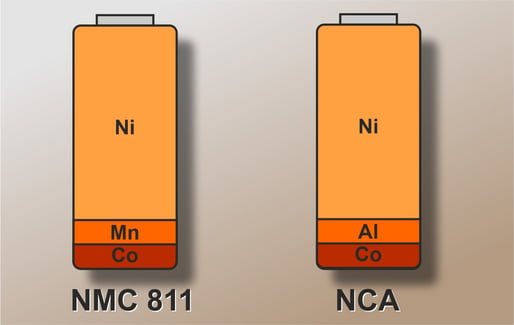
NMC and NCA are the two high-nickel lithium-ion chemistries that power the world's electric vehicles, drones, and premium electronics. They are close cousins — both rely on a nickel-rich layered oxide cathode — but the single-element difference between them (manganese versus aluminum) produces meaningful divergences in energy density, safety, cost, and longevity.
Most comparisons stop at listing specs. This guide goes deeper: it explains why each chemistry behaves the way it does at the crystal-structure level, backs the safety claims with peer-reviewed thermal-runaway data, provides current 2025 cost figures, and gives a clear framework for choosing between them. By the end, you'll understand not just which is "better" — a question with no universal answer — but which is right for a specific application, and why.
Part 1: The Chemistry — One Element Apart
Both NMC and NCA use a layered oxide cathode with a lithium-nickel backbone. The difference is the stabilizing element added to that backbone.
NMC (Nickel Manganese Cobalt Oxide) uses the formula LiNixMnyCozO2. The three metals are tuned in different ratios, written as NMC 811 (80% Ni, 10% Mn, 10% Co), NMC 622, and NMC 532. Each element plays a defined role: nickel provides capacity and energy density, manganese stabilizes the crystal structure and improves safety, and cobalt improves conductivity and cycle life. Raising the nickel proportion (toward 811) increases energy density but reduces thermal stability — the central trade-off in NMC design.
NCA (Nickel Cobalt Aluminum Oxide) uses the formula LiNixCoγAlzO2, typically around 80% nickel, 15% cobalt, and 5% aluminum. NCA swaps manganese for a small amount of aluminum, which stabilizes the crystal lattice at very high nickel content. Because NCA runs an even higher nickel fraction than most NMC variants and uses aluminum (which contributes no capacity but locks the structure), it achieves higher energy density — at the cost of being chemically more delicate.
The key insight: both are nickel-rich layered oxides, and both face the same fundamental tension. More nickel means more energy but less stability. NMC manages that tension with manganese; NCA manages it with aluminum at a higher nickel level, pushing energy density higher and safety margin lower.
Part 2: Head-to-Head Specification Comparison
| Feature | NMC | NCA |
|---|---|---|
| Cathode formula | LiNixMnyCozO2 | LiNixCoγAlzO2 |
| Typical composition | 811 / 622 / 532 | ~80% Ni, 15% Co, 5% Al |
| Gravimetric energy density | 150–250 Wh/kg (advanced up to ~300) | 200–260 Wh/kg |
| Nominal cell voltage | 3.6–3.7V | 3.6V |
| Cycle life (to 80% SOH) | 1,500–3,000 | 1,000–2,000 |
| Thermal runaway onset | ~150–210°C | ~150–200°C (more energetic) |
| Cobalt content | Moderate (lower in 811) | Higher (~15%) |
| Cost (2025, cell level) | $100–120/kWh | Typically higher |
| Best for | Standard & performance EVs, power tools, e-bikes | Long-range EVs, drones, aerospace |
Sources: BloombergNEF 2025, Electronics360, peer-reviewed thermal analyses (2025).
Part 3: Energy Density — NCA Leads, But the Gap Is Closing
NCA has historically held the energy-density crown, delivering 200–260 Wh/kg versus NMC's traditional 150–250 Wh/kg. This is why NCA became the chemistry of choice for applications where maximum range or run-time per kilogram is the deciding factor — most famously Tesla's earlier long-range vehicles.
But the advantage is narrowing. High-nickel NMC variants (NMC 811 and beyond) now push well into NCA's territory, with some advanced cells reaching 300 Wh/kg. For most buyers in 2025, the practical energy-density difference between a high-nickel NMC and a standard NCA cell is smaller than it was five years ago — and the choice increasingly turns on safety, cost, and cycle life rather than raw density.
Part 4: Safety — The Peer-Reviewed Reality
This is where the two chemistries genuinely diverge, and where the marketing language in most comparisons obscures the data.
A 2024 peer-reviewed study using accelerating rate calorimetry (ARC) on 18650 cells ranked the thermal runaway danger of four cathode chemistries by maximum temperature and heat release rate. The ranking, from most dangerous to least: LCO > NCA > NMC 811 >> LFP. In other words, NCA is more thermally hazardous than even high-nickel NMC 811 — and both nickel-rich chemistries are dramatically more hazardous than LFP.
The mechanism behind this is the cathode structure. Higher nickel and cobalt content increases capacity but worsens thermal stability, because nickel-rich layered oxides release oxygen more readily when they break down under heat. NCA's higher nickel fraction and aluminum stabilizer give it slightly less margin than NMC; the manganese in NMC contributes structural integrity that modestly improves its resistance to thermal runaway.
Practically, this means NMC has a safety edge over NCA — not a large one, but real and measurable. Both require sophisticated battery management systems and active thermal management. Neither approaches the intrinsic safety of LFP. For any application where a thermal event would be catastrophic, this ranking matters more than a few Wh/kg of energy density.
Part 5: Cycle Life and Cost
Cycle life: NMC generally outlasts NCA. The manganese in NMC's cathode adds structural stability that allows it to withstand more charge-discharge cycles before significant capacity loss — typically 1,500–3,000 cycles versus 1,000–2,000 for NCA. For applications demanding years of daily cycling, NMC's longevity advantage is a meaningful consideration.
Cost: Both chemistries are expensive relative to LFP because both depend on cobalt and nickel — scarce materials with volatile pricing (cobalt traded around $30–40/kg in 2025). NCA is typically the more expensive of the two, owing to its higher nickel content and the more complex manufacturing required to safely handle high-nickel chemistry. NMC's cost has fallen as newer high-nickel blends reduce cobalt content, but both remain well above LFP's roughly $80–90/kWh at the cell level.
Part 6: Applications — Which Chemistry Goes Where
| Application | Preferred Chemistry | Reasoning |
|---|---|---|
| Long-range premium EV | NCA (or high-Ni NMC) | Maximum range per kg; weight-constrained |
| Standard / performance EV | NMC | Balanced energy, safety, cost, cycle life |
| Power tools & e-bikes | NMC | High power bursts, durability, lower cost |
| Long-endurance drones / UAVs | NCA | Maximum flight time per kg of battery |
| Aerospace / satellites | NCA | Energy-to-weight ratio is decisive |
| Medical devices | NMC | Reliability, safety, long service life |
| High-end consumer electronics | NCA / NMC | Volumetric density in slim form factors |
The market pattern is clear: NCA dominates where weight and energy-per-kilogram are the binding constraints and the manufacturer has the engineering resources to manage its thermal demands — Tesla's long-range vehicles and high-endurance drones being the archetypes. NMC dominates the broader middle of the market — standard and performance EVs, power tools, medical devices — where its balance of safety, cost, cycle life, and adequate energy density makes it the versatile default. Notably, many automakers that once used NCA are migrating toward advanced high-nickel NMC (811), which narrows NCA's density advantage while retaining NMC's safety and cost benefits.
Frequently Asked Questions
Is NMC better than NCA?
It depends entirely on the application. NMC is the better all-rounder — it offers an excellent balance of safety, cost, and cycle life, making it the default for standard EVs, power tools, and medical devices. NCA is better when maximum energy density or run-time per kilogram is the priority and the engineering resources exist to manage its thermal demands, as in long-range EVs and high-endurance drones. Neither is universally superior; they are optimized for different constraints. NMC has a measurable safety and cycle-life edge; NCA has an energy-density edge.
Which is safer, NMC or NCA?
NMC is modestly safer. A peer-reviewed 2024 thermal study ranked thermal runaway danger as LCO > NCA > NMC 811 >> LFP, placing NCA as more hazardous than even high-nickel NMC. The manganese in NMC's cathode provides structural stability that improves resistance to thermal runaway, while NCA's higher nickel content makes it chemically more reactive. Both require sophisticated battery management and thermal systems, and both are far less thermally stable than LFP. If intrinsic safety is the absolute priority, LFP outperforms both nickel-rich chemistries by a wide margin.
Which has a longer cycle life, NMC or NCA?
NMC typically offers longer cycle life — roughly 1,500–3,000 cycles versus 1,000–2,000 for NCA. The manganese in NMC's cathode adds structural stability that allows the cell to withstand more charge-discharge cycles before degrading. NCA's higher nickel content, while boosting energy density, makes its crystal structure degrade slightly faster over many cycles. For applications requiring years of daily service, NMC's longevity is an advantage.
Why do some EVs like Tesla use NCA instead of NMC?
Automakers prioritizing maximum range historically chose NCA for its higher energy density (200–260 Wh/kg), which lets a vehicle travel farther without a larger or heavier pack. Tesla's long-range models famously used NCA for this reason. However, the gap has narrowed as high-nickel NMC (811) reaches comparable density with better safety and lower cost — and many manufacturers are now shifting toward advanced NMC blends, while affordable models increasingly use LFP.
What are the main disadvantages of NCA batteries?
NCA's two main drawbacks are thermal stability and cost. Its high nickel content makes it chemically more volatile than NMC, requiring sophisticated battery management and cooling systems to prevent thermal runaway. It is also more expensive, due to higher nickel content and the complex manufacturing needed to handle high-nickel chemistry safely. Additionally, NCA's cycle life is somewhat shorter than NMC's.
Conclusion
NMC and NCA are two solutions to the same engineering problem: how to extract maximum energy from a nickel-rich cathode while managing the instability that nickel brings. NCA answers with higher nickel and aluminum stabilization, winning on energy density at the cost of safety, cycle life, and price. NMC answers with manganese stabilization across tunable ratios, winning on safety, cycle life, and cost while now closing the density gap through high-nickel variants.
For the long-range EV or the endurance drone where every kilogram counts, NCA remains compelling. For the broad middle of the market — standard EVs, power tools, medical devices, anywhere balance matters — NMC is the versatile choice. And for any application where intrinsic safety or lowest lifetime cost outranks energy density, the honest answer is that neither nickel-rich chemistry wins — LFP does. Match the chemistry to the constraint that actually governs your application, and the right choice becomes clear.
- Next:DIY Solar Power Station for Beginners: Sizing, Components & Step-by-Step Build
- Previous:How to Choose the Right Leaf Blower Battery: Voltage, Ah, Runtime & CFM Explained
Contact Details
Lithium LiFePO4 Batteries and Lithium LiFePO4 Cells Supplier - LiFePO4 Battery Shop
Contact Person: Miss. Elena Wang
WhatsApp : +8615263269227
Skype : +8615263269227
WeChat :15263269227
Email : info@lifepo4batteryshop.com
All Products
- TC Elcon Charger (0)
- Headway Lithium Battery (6)
- Blade Battery (10)
- Semi Solid State Battery (6)
- A123 Battery (6)
- Sinopoly Battery (7)
- GBS Battery (16)
- CALB Battery (26)
- Cylindrical Cell (14)
- Energy Storage System (0)
- Battery Management System (15)
- Sodium ion Battery Cell (4)
- Lithium Titanate Battery (23)
- Ternary Lithium Battery Cell (12)
- REPT Battery (10)
- BYD Battery (5)
- CATL Battery (15)
- Thunder Sky Winston Battery (26)
- EVE Battery (37)
- LiFePO4 Battery Cell (33)
Certification
Customer Reviews
- I have fond memories of our meeting in Shanghai with LiFePO4 Battery Shop Elena. Your company left a strong impression on me with its impressive growth and professionalism. We both value straightforwardness and honesty, which I believe are the most important qualities in any partnership. I am confident that we can build a successful collaboration based on these shared values. —— Robert from USA
- I've been working with LiFePO4 Battery Shop for years, and their reliability is unmatched. While other suppliers frequently change sales teams, LiFePO4 Battery Shop has consistently provided exceptional service with a stable team. Their commitment to quality and customer support truly sets them apart. —— Henry from Australia