
Blog
A Complete Guide to Ternary Lithium Battery: NMC Technology, Performance & Applications (2026)
2026-05-02 | Calvin
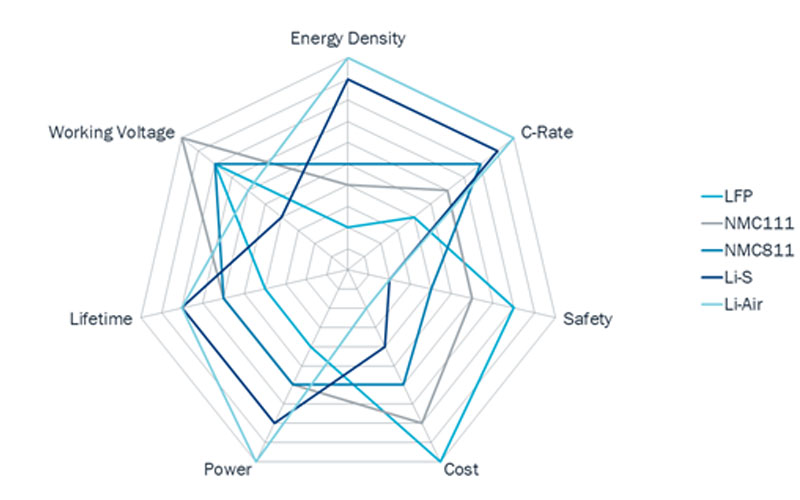
The global push toward electrification - from electric vehicles and grid-scale energy storage to portable electronics - has placed lithium-ion batteries at the center of modern energy technology. Among the various chemistries available, the ternary lithium battery stands out as one of the most powerful and widely deployed solutions, dominating sectors where energy density and weight efficiency are critical.
But what exactly is a ternary lithium battery? How does it differ from LiFePO4? And is it the right choice for your application - whether you're designing an EV, building a solar storage system, or sourcing cells for industrial use?
This comprehensive guide breaks down everything you need to know about ternary lithium batteries (also called NMC or NCM batteries), including their chemistry, performance, advantages, limitations, and how they compare to alternative technologies.
What Is a Ternary Lithium Battery?
A ternary lithium battery is a type of lithium-ion battery that uses a cathode material composed of three transition metals - typically nickel (Ni), cobalt (Co), and manganese (Mn) - combined with lithium and oxygen. The term "ternary" simply refers to this three-metal composition.
This chemistry is most commonly known as NMC (Nickel Manganese Cobalt) or NCM, with the abbreviations being interchangeable depending on regional preference. A closely related variant, NCA (Nickel Cobalt Aluminum), replaces manganese with aluminum and is widely used by Tesla.
Each of the three metals contributes a distinct property to the battery's overall performance:
Table 1: Role of Each Metal in NMC Cathodes
| Metal | Primary Function | Performance Contribution |
|---|---|---|
| Nickel (Ni) | Energy storage | Increases capacity and energy density |
| Cobalt (Co) | Structural stabilizer | Improves cycle life and conductivity |
| Manganese (Mn) | Safety enhancer | Reduces thermal risk and lowers cost |
By adjusting the ratio of these metals, manufacturers can fine-tune the battery's behavior to favor energy, power, longevity, or cost - making NMC one of the most versatile lithium-ion chemistries available.
How Does a Ternary Lithium Battery Work?
Like all lithium-ion batteries, a ternary lithium battery operates on the principle of reversible lithium-ion intercalation between the cathode and anode.
During charging, lithium ions are extracted from the NMC cathode, travel through the electrolyte, and embed themselves in the graphite anode. During discharging, the process reverses - ions migrate back to the cathode while electrons flow through the external circuit, powering the connected device.
A complete ternary lithium battery system typically consists of three core components:
- Battery cell - the electrochemical unit where energy storage occurs
- Battery Management System (BMS) - monitors voltage, temperature, and current to ensure safe operation
- Protective housing - provides mechanical protection and thermal isolation
It's worth noting that NMC and NCA, while both ternary chemistries, behave differently. NMC offers a balanced profile suitable for a wide range of applications, while NCA delivers higher energy density at the cost of greater thermal sensitivity - which is why it's primarily reserved for premium electric vehicles.
Types of Ternary Lithium Batteries (NMC Variants)
Not all ternary lithium batteries are created equal. Over the past decade, NMC formulations have evolved to push energy density higher while reducing dependence on expensive cobalt. The naming convention reflects the metal ratio - for instance, NMC811 contains 80% nickel, 10% manganese, and 10% cobalt.
Table 2: Comparison of Major NMC and NCA Variants
| Variant | Ni:Mn:Co Ratio | Energy Density (Wh/kg) | Cycle Life | Cost | Typical Applications |
|---|---|---|---|---|---|
| NMC111 | 1:1:1 | 140-180 | 1,000-2,000 | High | Early EVs, power tools |
| NMC532 | 5:3:2 | 160-200 | 1,000-2,000 | Medium-High | EVs, e-bikes |
| NMC622 | 6:2:2 | 180-230 | 1,000-1,500 | Medium | Mainstream EVs |
| NMC811 | 8:1:1 | 230-280 | 800-1,500 | Lower (less Co) | Long-range EVs, drones |
| NCA | 8:1.5:0.5 (Al) | 240-290 | 800-1,000 | Medium-High | Tesla, premium EVs |
Cycle Life and Lifespan of Ternary Lithium Batteries
The cycle life of a battery refers to the number of full charge-discharge cycles it can complete before its capacity drops below 80% of the original rated value. For ternary lithium batteries, the typical cycle life ranges from 800 to 2,000 cycles, depending on the specific NMC variant and operating conditions.
In real-world terms, this translates to roughly 3 to 8 years of service life under moderate use - significantly shorter than LiFePO4 batteries but adequate for most consumer and automotive applications.
Several factors strongly influence the lifespan of a ternary lithium battery:
- Operating temperature - Optimal performance occurs around 25°C; extreme heat accelerates degradation
- Depth of discharge (DOD) - Shallower discharges (e.g., 20-80% SOC) extend cycle life dramatically
- Discharge rate (C-rate) - Higher current draw causes faster capacity fade
- Charging protocol - Constant current/constant voltage (CC/CV) charging at moderate rates is ideal
- Cell consistency - In multi-cell packs, mismatched cells reduce overall lifespan
For applications requiring decades of service - such as residential solar storage - alternative chemistries like LiFePO4 typically offer better long-term value despite their lower energy density.
Advantages of Ternary Lithium Batteries
- High energy density - At 200-290 Wh/kg, NMC and NCA offer the highest practical energy density among commercial lithium-ion batteries, enabling longer EV ranges and lighter portable electronics.
- Higher voltage platform - A nominal cell voltage of 3.7V (compared to 3.2V for LiFePO4) means fewer cells are needed to reach a target system voltage, reducing pack complexity and cost.
- Superior low-temperature performance - Ternary lithium batteries retain over 70% of their capacity at -20°C, making them well-suited for cold climates and aerospace applications.
- Fast-charging capability - Modern NMC cells can accept charge rates of 2-3C, supporting rapid charging in EVs and power tools.
- Compact and lightweight - High gravimetric and volumetric energy density enables space-constrained designs in drones, e-bikes, and consumer electronics.
- Recyclability - With recycling rates exceeding 95%, valuable metals like nickel and cobalt can be recovered, reducing environmental impact and material costs.
Disadvantages and Safety Concerns
Despite their performance advantages, ternary lithium batteries come with notable trade-offs that buyers and engineers must consider.
The most significant concern is thermal stability. NMC cathodes begin to decompose at approximately 200°C, releasing oxygen that can fuel a thermal runaway event. While this risk is managed effectively in well-engineered packs, incidents involving damaged or counterfeit cells continue to make headlines.
Additional drawbacks include:
- Shorter cycle life compared to LiFePO4 (typically 800-2,000 vs. 2,000-6,000 cycles)
- Higher material costs due to nickel and cobalt content
Modern ternary lithium battery packs mitigate these risks through multi-layered safety systems: advanced BMS protection, active or passive cooling, flame-retardant materials, pressure relief vents, and cell-level fusing. Major manufacturers like Tesla, BYD, and CATL have invested heavily in these technologies, making contemporary NMC packs significantly safer than earlier generations.
Ternary Lithium Battery vs LiFePO4 vs LTO
Choosing the right lithium-ion chemistry depends entirely on your application. The three most prominent options - NMC, LiFePO4 (LFP), and Lithium Titanate (LTO) - each excel in different scenarios.
Table 3: NMC vs LiFePO4 vs LTO Comparison
| Feature | Ternary (NMC/NCA) | LiFePO4 (LFP) | LTO |
|---|---|---|---|
| Energy Density | 200-290 Wh/kg | 90-160 Wh/kg | 50-80 Wh/kg |
| Nominal Voltage | 3.7V | 3.2V | 2.3V |
| Cycle Life | 800-2,000 | 2,000-6,000 | 10,000-25,000 |
| Thermal Safety | Moderate | High | Very High |
| Low-Temp Performance | Excellent | Moderate | Excellent |
| Cost per kWh | Higher | Lower | Highest |
| Best For | EVs, electronics, drones | Solar storage, RVs, marine | Industrial, fast-charge transit |
Applications of Ternary Lithium Batteries
- Electric Vehicles (EVs) - Tesla, BMW, Mercedes-Benz, Hyundai, and numerous other automakers rely on NMC or NCA batteries for their long-range models, where every kilogram of weight directly impacts driving range.
- Consumer Electronics - Smartphones, laptops, tablets, and wearables benefit from the compact form factor enabled by NMC's high volumetric energy density.
- Power Tools - High-discharge NMC cells provide the burst current needed for cordless drills, saws, and industrial equipment.
- Drones and UAVs - Energy density is mission-critical for flight time, making NMC and NCA the standard for both consumer and commercial drones.
- E-bikes and Light EVs - Riders prioritize range and weight, making ternary chemistry the natural fit.
- Aerospace and Specialty Applications - Where exceptional energy-to-weight ratios justify the higher cost.
While NMC has historically been used in some grid-scale energy storage projects, the industry is shifting decisively toward LiFePO4 for stationary applications due to its superior safety and longevity.
Frequently Asked Questions (FAQ)
- What is the difference between NMC and NCM? There is no chemical difference - NMC and NCM are simply different abbreviations for the same Nickel-Manganese-Cobalt cathode chemistry. NMC is more common in Western markets, while NCM is widely used in China and parts of Asia.
- How long does a ternary lithium battery last? A typical ternary lithium battery lasts 800 to 2,000 charge cycles, translating to roughly 3 to 8 years of service life under normal use. Lifespan depends heavily on temperature, depth of discharge, and charging habits.
- Are ternary lithium batteries safer than LiFePO4? No. LiFePO4 batteries are generally considered safer due to their superior thermal stability - they remain stable up to around 270°C, while NMC begins to decompose near 200°C. However, modern NMC packs with advanced BMS and cooling systems are very safe in practice.
- Can ternary lithium batteries be used for solar storage? Yes, but they are not the optimal choice. While NMC works for solar applications, LiFePO4 is preferred for residential and commercial solar storage due to its longer cycle life, better safety profile, and lower long-term cost.
- What is the energy density of ternary lithium batteries? The energy density of ternary lithium batteries typically ranges from 200 to 290 Wh/kg, depending on the specific NMC variant. NMC811 and NCA cells achieve the highest values, while NMC111 sits at the lower end.
Conclusion
Ternary lithium batteries represent one of the most important breakthroughs in modern energy technology, combining high energy density, strong voltage performance, and excellent low-temperature capability. They have rightfully earned their dominant position in electric vehicles, consumer electronics, and high-performance portable applications.
That said, they are not a one-size-fits-all solution. Their moderate cycle life, thermal sensitivity, and dependence on cobalt make alternative chemistries like LiFePO4 a better fit for stationary storage, marine, and long-life applications.
Looking ahead, ongoing innovation in high-nickel cathodes, solid-state electrolytes, and cobalt-free formulations promises to address many of the current limitations of ternary lithium technology.
- Next:How do BMS, EMS, and PCS Achieve Safe Collaboration in Energy Storage Systems?
- Previous:26650 vs 18650 Lithium Batteries: A Comprehensive Comparison
Contact Details
Lithium LiFePO4 Batteries and Lithium LiFePO4 Cells Supplier - LiFePO4 Battery Shop
Contact Person: Miss. Elena Wang
WhatsApp : +8615263269227
Skype : +8615263269227
WeChat :15263269227
Email : info@lifepo4batteryshop.com
All Products
- TC Elcon Charger (0)
- Headway Lithium Battery (6)
- Blade Battery (10)
- Semi Solid State Battery (6)
- A123 Battery (6)
- Sinopoly Battery (7)
- GBS Battery (16)
- CALB Battery (25)
- Cylindrical Cell (9)
- Energy Storage System (0)
- Battery Management System (11)
- Sodium ion Battery Cell (4)
- Lithium Titanate Battery (22)
- Ternary Lithium Battery Cell (12)
- REPT Battery (10)
- BYD Battery (5)
- CATL Battery (15)
- Thunder Sky Winston Battery (26)
- EVE Battery (35)
- LiFePO4 Battery Cell (17)
Certification
Customer Reviews
- I have fond memories of our meeting in Shanghai with LiFePO4 Battery Shop Elena. Your company left a strong impression on me with its impressive growth and professionalism. We both value straightforwardness and honesty, which I believe are the most important qualities in any partnership. I am confident that we can build a successful collaboration based on these shared values. —— Robert from USA
- I've been working with LiFePO4 Battery Shop for years, and their reliability is unmatched. While other suppliers frequently change sales teams, LiFePO4 Battery Shop has consistently provided exceptional service with a stable team. Their commitment to quality and customer support truly sets them apart. —— Henry from Australia