News
Trump Signs Executive Order: Battery Energy Storage Systems Included in Ban List
2026-09-03 | Calvin
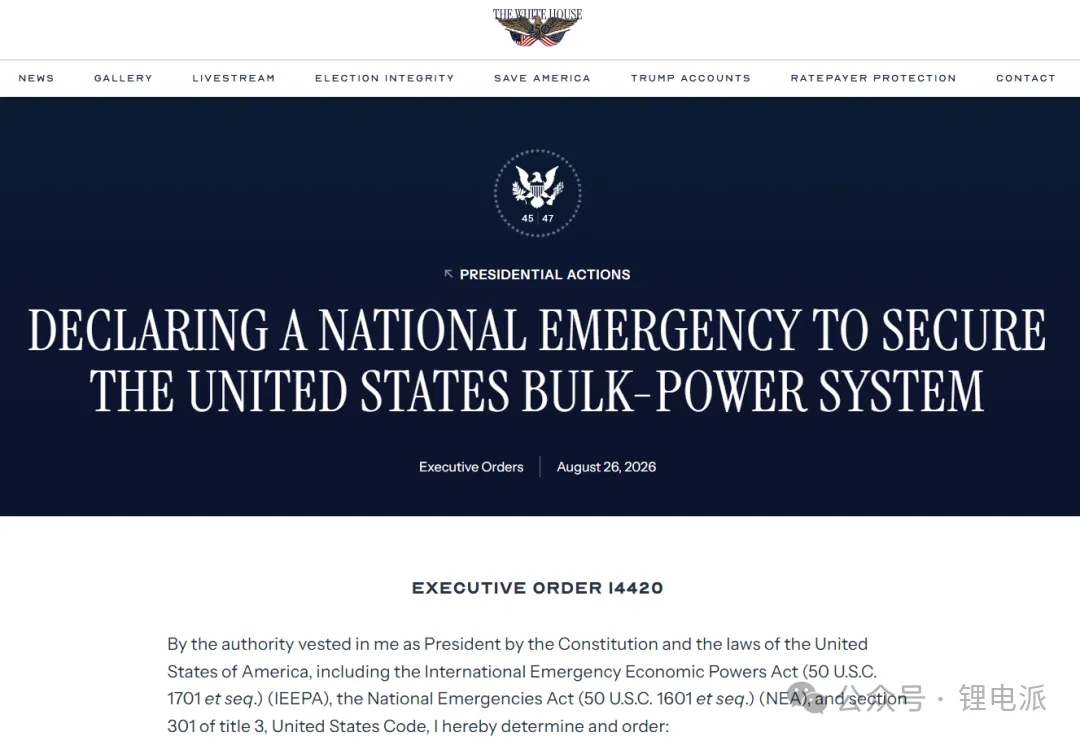
The United States has begun to review foreign energy storage equipment from a national security perspective.
On August 26, President Trump signed the Executive Order "Declaring a National Emergency to Secure the United States Bulk-Power System" (Executive Order 14420).
Beyond large power transformers, generators, and circuit breakers, Battery Energy Storage Systems (BESS), grid-tied inverters, and uninterruptible power supplies serving critical infrastructure are now explicitly listed for the first time under this national security review.
Critical components, software, firmware, digital services, maintenance services, and remote access functions within the equipment may also become subjects of the review.
This means that for Chinese energy storage products entering the U.S., they now face not just tariffs and tax credit restrictions. The U.S. government will have more direct administrative authority to decide whether products can be imported, deployed, or continue to operate.
Currently, the executive order directly targets BESS, inverters, and other bulk-power system equipment, without singling out battery cells, nor does it announce a blanket ban on all Chinese energy storage products. Specific implementation rules will be formulated by the U.S. Department of Energy within the next 120 days.
The Ban Directly Targets BESS, But Does Not Yet Name Battery Cells
Under the executive order, a transaction will be prohibited if it fails to meet the requirements across three dimensions: equipment origin, associated entities, and risk assessment.
Specifically, if the equipment is not manufactured, produced, or assembled in the United States; if the equipment, its critical components, software, maintenance services, or remote access functions involve a "foreign entity of concern"; and if the Secretary of Energy determines that it could pose risks of disruption, unauthorized access, malicious remote operation, supply interruption, or other national security risks.
Upon making such a determination, the Secretary of Energy can prohibit the procurement, importation, transfer, and installation of the equipment. For equipment already in operation, the Department of Energy may require its identification, isolation, monitoring, hardening, disconnection, replacement, or even removal.
Battery cells are not explicitly mentioned in this executive order. However, even before this order, the U.S. had already implemented other policies to directly restrict Chinese batteries and their suppliers.
The first is defense procurement restrictions.
The National Defense Authorization Act for Fiscal Year 2024 stipulates that, starting from October 2027, the U.S. Department of Defense shall not procure batteries produced by six Chinese companies: CATL, BYD, Envision Energy, EVE Energy, Gotion High-tech, and Hithium Energy.
The second is Section 301 tariffs.
From 2026, the additional Section 301 tariff on Chinese non-EV lithium-ion batteries will increase from 7.5% to 25%. Stationary energy storage batteries are thus directly subjected to higher import costs.
The third is the PFE (domestic content) requirement.
For energy storage projects commencing construction in 2026, the proportion of direct equipment costs from non-PFE sources must reach 55%, a threshold that will increase annually in subsequent years.
Section 301 tariffs raise import costs; PFE rules limit tax credits; defense procurement already names and restricts some Chinese battery companies; the new executive order leaves open the possibility of further scrutinizing battery cells through "critical components."
Under the combined pressure of these various policies, even though battery cells are not directly named in this executive order, they have long been at the center of U.S. battery supply chain policy.
The More Needed, The More Banned
The U.S. restricts Chinese energy storage precisely at a time when it needs it most.
In 2025, the U.S. added 57.6 GWh of new energy storage capacity, a year-on-year increase of about 30%. In 2026, an additional 60 GWh is expected. Artificial intelligence, data centers, advanced manufacturing, and defense production are simultaneously driving up electricity demand.
This growing demand continues to translate into imports.
In the second quarter of 2026, the U.S. imported 215,900 tons of lithium-ion batteries, with energy storage and other non-EV uses accounting for nearly 90%. China accounted for 66.5% of the total weight of U.S. lithium-ion battery imports, up from 60.3% in the first quarter.
The U.S. still cannot do without Chinese batteries, but it has begun to develop the capability to replace some Chinese battery supplies.
As of February 2026, the U.S. had approximately 69 GWh of battery pack manufacturing capacity, but cell production capacity was only about 22 GWh, with another 108 GWh under construction. By the end of 2025, the U.S. had three LFP energy storage cell factories in production, with seven more expected to come online by the end of 2026. If projects proceed on schedule, nameplate capacity could potentially cross the demand threshold by the end of this year.
LG Energy Solution plans to build over 50 GWh of LFP energy storage cell capacity in North America by the end of 2026, and Samsung SDI is also converting its U.S. automotive battery lines for energy storage. The U.S. is not rejecting all foreign suppliers; rather, it is building a supply chain centered on U.S. manufacturing, absorbing trusted allied companies, and excluding so-called high-risk sources.
Even if the cell gap is filled, a significant portion of cathode and anode materials, separators, electrolytes, lithium salts, and some manufacturing equipment remain concentrated in China and Asia.
From Bulk-Power System Security to Energy Sovereignty
The Trump administration appears contradictory in many of its energy policies.
It cuts support for wind and solar power while retaining high subsidies for battery manufacturing. It emphasizes market competition while using tariffs, tax credits, government procurement, and national emergency powers to intervene in corporate purchasing decisions. It restricts foreign equipment while welcoming South Korean companies to produce batteries in the U.S.
However, when viewed along a different axis, these actions become consistent:
Energy must be abundant and dispatchable when needed; critical equipment should be produced as much as possible within the U.S. and its allied systems; software, maintenance, and supply chains must not be controlled by potential adversaries.
This is not a traditional energy transition.
It more closely resembles an energy sovereignty framework that emphasizes abundance, reliability, localization, and control.
This path can be summarized as: first, make Chinese supply more expensive; then, make it harder for it to receive subsidies; simultaneously, support U.S. and allied production capacity; and finally, retain the direct authority to prohibit equipment from entering and operating in the U.S.
The U.S. used a similar framework in 2020.
That year, Trump signed Executive Order 13920, authorizing the Secretary of Energy to restrict foreign equipment that could threaten the bulk-power system. The final prohibition order was relatively narrow in scope, primarily affecting some grid equipment serving critical defense facilities and operating at 69kV and above.
Six years later, the scope of review has expanded from transformers and circuit breakers to include BESS, grid-tied inverters, UPS, software, remote access, and supply chain dependencies.
The policy focus has shifted from "preventing a batch of equipment from attacking the grid" to "ensuring the entire bulk-power system is controlled by the United States."
U.S. energy policy thus presents a state of high anxiety, high conservatism, and high administrative intervention.
The eventual supply chain boundaries are not simply U.S. versus foreign, but rather: U.S. manufacturing plus trusted allied supply chains versus supply chains defined as high-risk.
Over the next 120 days, how the Department of Energy defines critical components, foreign entities of concern, and supply chain risks will determine whether the restrictions faced by Chinese energy storage remain primarily a set of security rules targeting complete BESS and control rights, or whether they will penetrate down to market access restrictions on battery cells.
With tariffs, PFE requirements, and defense procurement already tightened in succession, the authority to decide whether Chinese battery cells can enter the U.S. energy storage market has now been consolidated by Executive Order 14420.
- Next: SP188 Maritime Shipping Rule Overhaul: Fading Shipping Privileges for Small Cylindrical Li-Ion Batteries
- Previous: Gotion Showcases at Intersolar South America
Contact Details
Lithium LiFePO4 Batteries and Lithium LiFePO4 Cells Supplier - LiFePO4 Battery Shop
Contact Person: Miss. Elena Wang
WhatsApp : +8615263269227
Skype : +8615263269227
WeChat : 15263269227
Email : info@lifepo4batteryshop.com
All Products
Certification
Customer Reviews
- I have fond memories of our meeting in Shanghai with LiFePO4 Battery Shop Elena. Your company left a strong impression on me with its impressive growth and professionalism. We both value straightforwardness and honesty, which I believe are the most important qualities in any partnership. I am confident that we can build a successful collaboration based on these shared values. —— Robert from USA
- I've been working with LiFePO4 Battery Shop for years, and their reliability is unmatched. While other suppliers frequently change sales teams, LiFePO4 Battery Shop has consistently provided exceptional service with a stable team. Their commitment to quality and customer support truly sets them apart. —— Henry from Australia