
News
Musk Announces Scaled Mass Production of 4680 Battery Dry Electrode Technology
2026-02-07 | Calvin
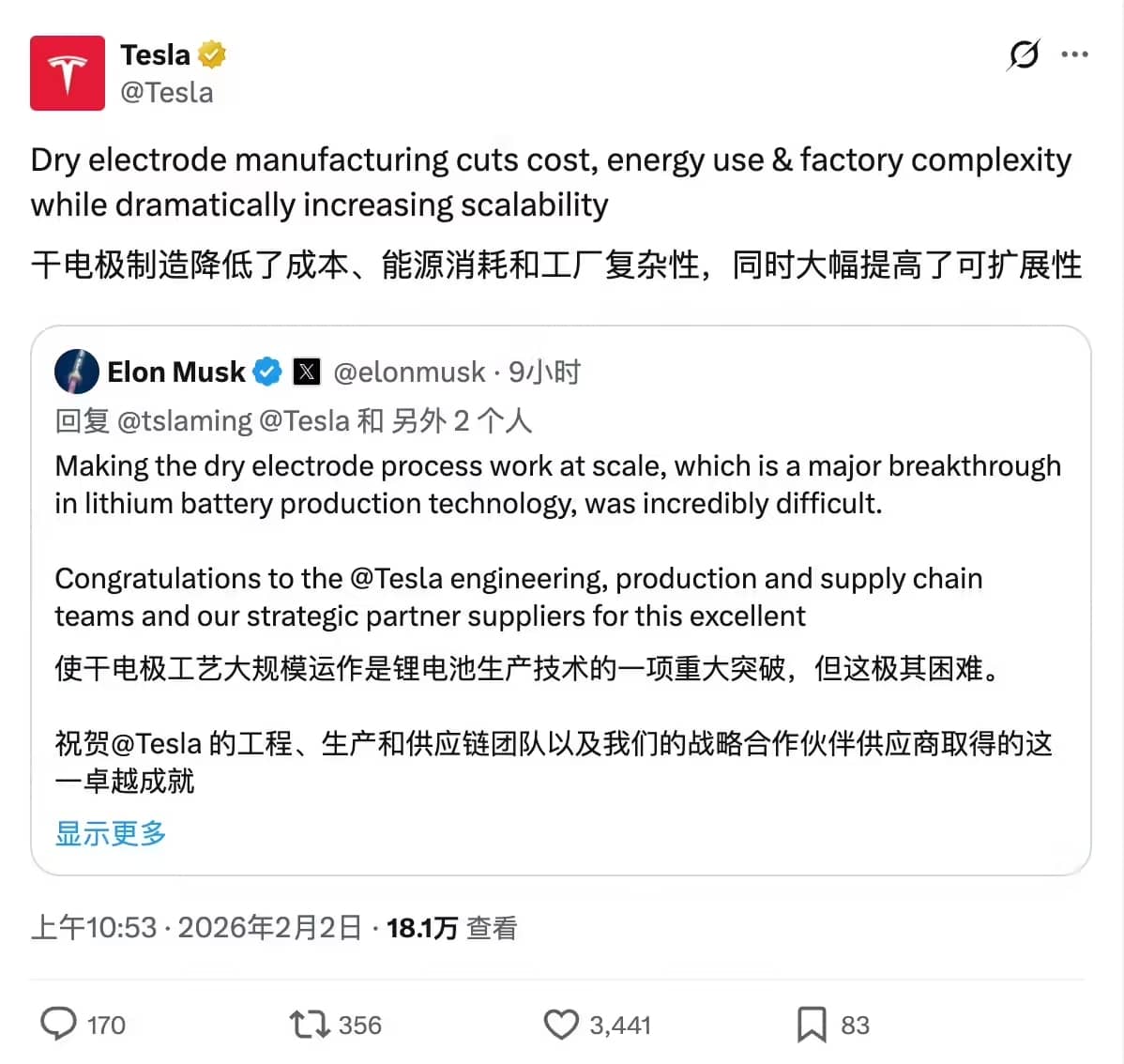
Recently, Elon Musk announced on social media platform X that Tesla has achieved scaled mass production of the dry electrode process—a major breakthrough in lithium battery manufacturing technology, widely regarded as extremely challenging.
As the core process behind Tesla’s bet on the 4680 large-format cylindrical battery, the mass-production challenge of dry electrode technology has been one of the biggest bottlenecks over the past several years.
The dry electrode process was introduced by Tesla in 2020 as a key proprietary technology. By eliminating traditional solvent-based coating and drying steps, it aims to simplify manufacturing, reduce costs (by more than 50%), and significantly cut energy consumption.
In terms of vehicle deployment, dry-process 4680 batteries were originally planned to debut on the Cybertruck. However, for a long period, Cybertruck production struggled due to unresolved issues with scaling the dry electrode process.
In its latest earnings report, Tesla stated that it has begun producing certain Model Y vehicles equipped with 4680 battery packs, adding a new supply source to address increasingly complex supply chain challenges driven by trade barriers and tariff risks.
The return of the 4680 large cylindrical battery to the Model Y lineup, combined with Musk’s official announcement of scaled dry electrode production, raises a key question: does this signal that dry-process 4680 batteries have officially entered the Model Y?
One critical detail is Tesla’s recent disclosure that its Austin, Texas factory has achieved mass production of 4680 batteries using the dry electrode process, with both cathode and anode materials manufactured locally.
As Tesla’s primary U.S.-based Gigafactory, the Texas facility is responsible not only for mass production of the Cybertruck and Model Y, but also for breakthroughs in yield and scale for dry-process 4680 batteries.
What tangible cost and efficiency benefits could dry-process 4680 batteries bring to the Model Y?
First, Tesla’s dry-process 4680 large-format cylindrical battery is a comprehensive product integrating multiple technological and material innovations, including a tabless (full-tab) design, high-nickel cathodes, silicon-based anodes, and the dry electrode manufacturing process.
According to Musk’s original projections, the dry-process 4680 cell could deliver a fivefold increase in cell-level energy density, a 16% improvement in driving range, a sixfold increase in power output, and a 56% reduction in cost per kilowatt-hour.
Leveraging the packaging advantages of large cylindrical cells, testing organizations have evaluated Tesla’s tabless 4680 battery and found that internal resistance was reduced by 70%, while peak charge and discharge capability increased sixfold. This implies a significant leap in fast-charging performance, with the potential to achieve 0–80% charging in around 10 minutes.
In comparison, fast charging has already become a core competitive focus for leading battery manufacturers in the Chinese market. If Tesla’s dry-process 4680 batteries are deployed at scale in the Model Y, this could further strengthen Tesla’s competitive position in the North American market.
Moreover, equipping the Model Y with dry-process 4680 batteries could unlock a new phase of performance growth for Tesla, driven by cost advantages.
Tesla’s financial reports show that automotive revenue reached USD 69.526 billion in 2025, down 10% year-on-year, while combined deliveries of the Model 3 and Model Y totaled 1.5853 million units, a 7% decline year-on-year.
Considering Tesla’s decision to scale back production lines for the Model S and Model X, the Model Y—configured with dry-process 4680 large cylindrical batteries—may become the company’s core business in 2026. The Model Y lineup has already evolved into multiple variants, including the Standard Range, Long Range, and Model YL. As mass production of dry-process 4680 batteries ramps up, full deployment across all Model Y variants is increasingly likely.
- Next: CATL Details Its New-Generation 5C Battery: Still 80% Capacity After 1.8 Million Kilometers
- Previous: Tesla Launches Domestic Solar Cell Manufacturing Plan in the U.S., Aims to Achieve Elon Musk's "100 GW per Year" Goal by 2028
Contact Details
Lithium LiFePO4 Batteries and Lithium LiFePO4 Cells Supplier - LiFePO4 Battery Shop
Contact Person: Miss. Elena Wang
WhatsApp : +8615263269227
Skype : +8615263269227
WeChat : 15263269227
Email : info@lifepo4batteryshop.com
All Products
Certification
Customer Reviews
- I have fond memories of our meeting in Shanghai with LiFePO4 Battery Shop Elena. Your company left a strong impression on me with its impressive growth and professionalism. We both value straightforwardness and honesty, which I believe are the most important qualities in any partnership. I am confident that we can build a successful collaboration based on these shared values. —— Robert from USA
- I've been working with LiFePO4 Battery Shop for years, and their reliability is unmatched. While other suppliers frequently change sales teams, LiFePO4 Battery Shop has consistently provided exceptional service with a stable team. Their commitment to quality and customer support truly sets them apart. —— Henry from Australia